back to MISCELLANEOUS HISTORY index
Moy School opened in 1895. In 1996, former and present staff and pupils published a booklet to celebrate its centenary. The booklet is recreated below in a digital-friendly format, or you can download an exact reproduction in PDF format HERE.
PRICE £2.00
All profits to school funds
MOY SCHOOL
THE FIRST HUNDRED YEARS
A Centennial Souvenir
This castle hath a pleasant seat; the air
Nimbly and sweetly recommends itself
Unto our gentle senses.
[Macbeth Act 1 Sc IV]
©The Board, Parents and Teachers
of
Moy Primary School
1996
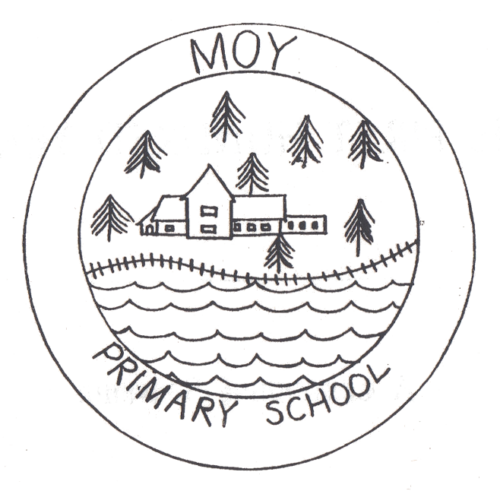
The Logo Of Moy Primary School,
symbolising its situation among pinewoods
with loch, road and railway close by,
was designed by
Tessa Wilson
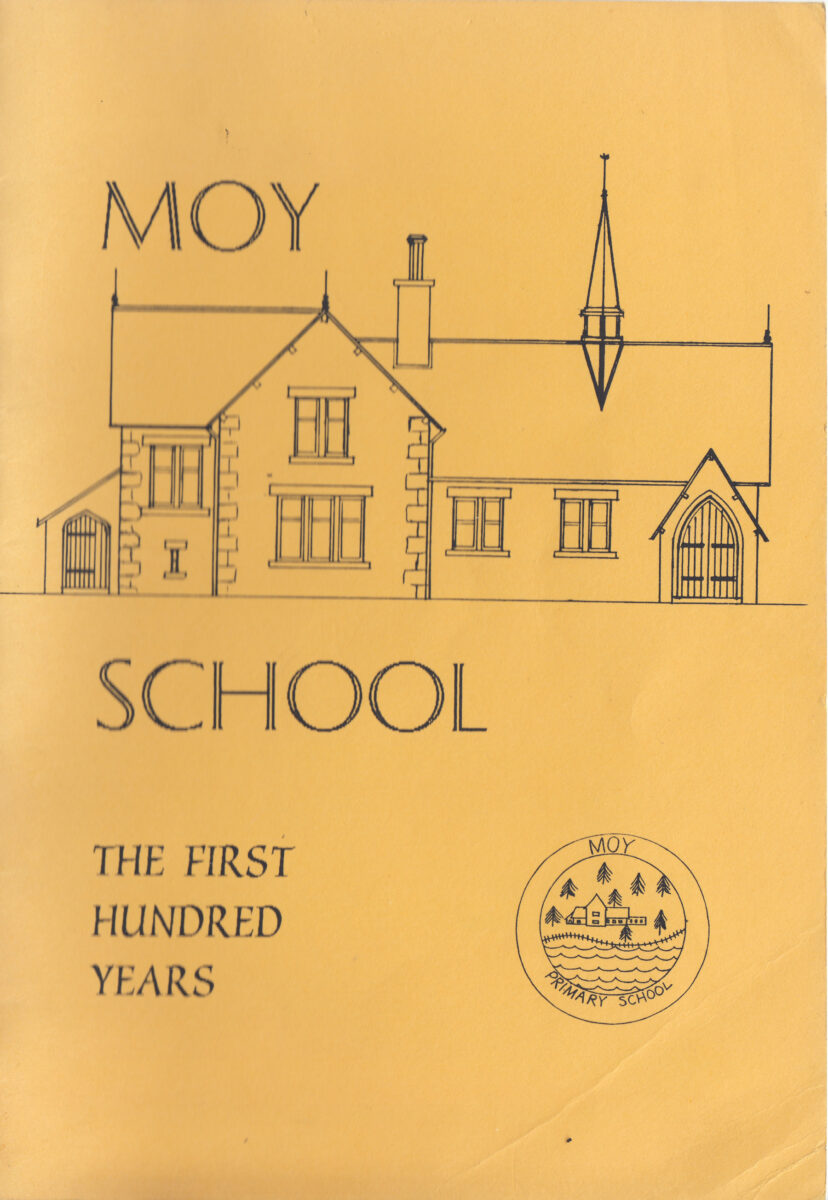
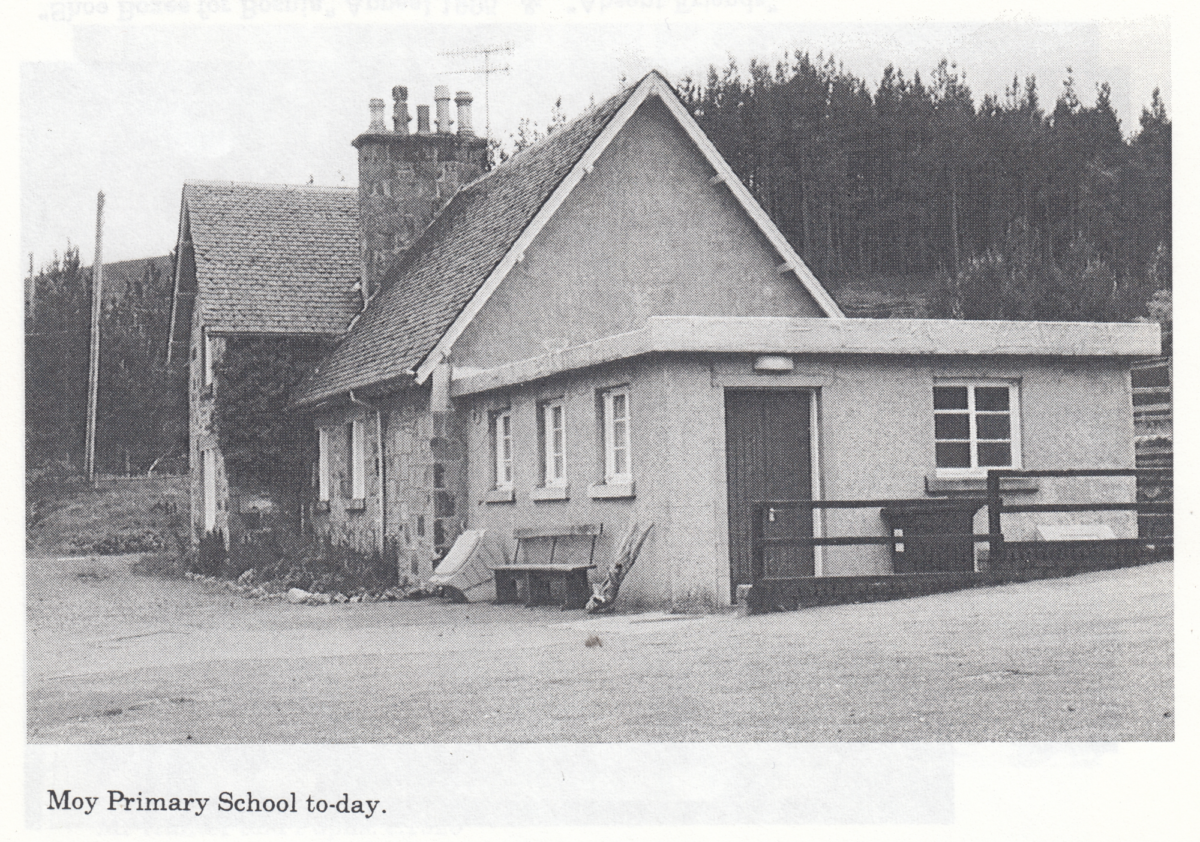
The drawing on the front cover is based on an old
photograph and shows the school as it was about 1913.
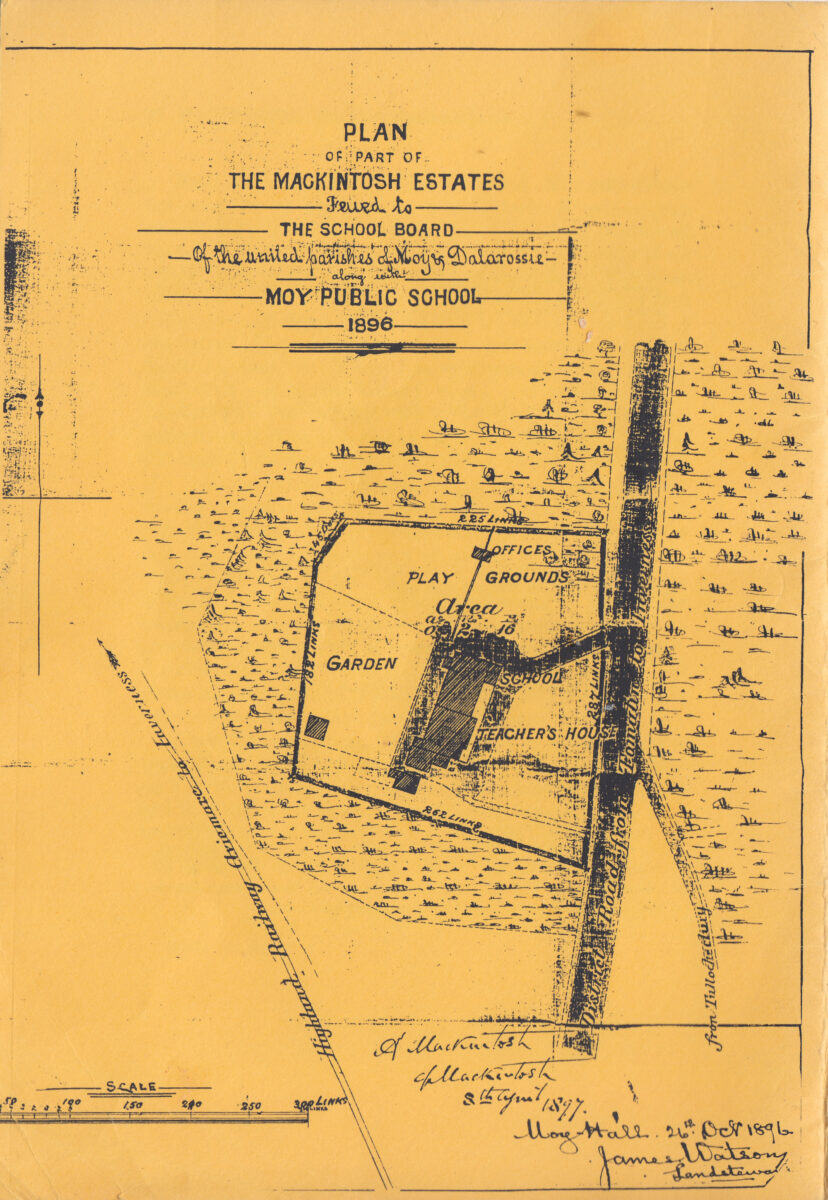
The illustration on the back cover is a plan of the feu
granted by The Mackintosh to the School Board of the
United Parishes of Moy and Dalarossie in 1886.
MOY SCHOOL:The First Hundred Years
was typeset with Locoscript 3
and printed by
PRONTOPRINT, Inverness
Moy Primary School has always been at the heart of the community in Moy. It provides its pupils with a solid foundation for their education as well as giving its children a strong sense of belonging to Moy and the Highlands.
I can remember the care and guidance given to me so fondly by my teachers Mrs Adamson and Mrs MacTavish. The enjoyable activites we indulged in both in and out of the classroom, in the peaceful environment that Moy provides, encouraged me and enabled me to develop productively.
I wish pupils and teachers past and present all the best on the School’s Centenary and hope that the School may flourish and continue to educate and enthral young minds for a hundred more years.
John Mackintosh of Mackintosh.
FOREWORD
Rural schools in the Highlands are increasingly under threat of closure. We at Moy are lucky that the school has attained its centenary and is still going strong. Closure is ultimately inevitable but I am sure that this booklet will serve as one form of permanent reminder of the school’s history and of the marvellous evening of celebration to mark the occasion of the centenary.
I join with the sentiments of gratitude expressed elsewhere to all concerned and would like, in addition, to express special thanks to Jamie Scarlett for the time and trouble taken and effort expended in producing this souvenir booklet.
Michael A Brady,
Chairman of the Board of Moy School,
Moy,
June 1996
MOY SCHOOL THEN AND NOW.
Moy School began operating in 1895, replacing the earlier Free Church School at Tullochclury; the first pupils -fourteen of them – were registered on 21st March. In those days there were many more people living in Moy than live there now. Houses that have entirely disappeared – Altnaslanach and Ach na Gall, for example – and others that are ruinous, such as Dalriach, were inhabited. Places that now boast only one or two houses were thriving settlements, Moy Hall and the Estate carried a large staff and the Railway, on its way from Aviemore to Inverness, had brought in permanent way and Station staff.
Those fourteen pioneers were quickly followed by others, to the extent that, by the end of 1895, a total of fifty-nine pupils had been enrolled while seven had left, some to find work, some to go to school in Inverness, and several because their families had moved away. “Left the district” and “Went back to England” and similar reasons are often given for a child’s departure; perhaps the father was a railway man promoted to another post, or a construction engineer who presence was no longer required when the railway was finished. “To work” is the commonest reason for leaving, but a sizeable number went on to continue their education in Inverness at the Royal Academy and other schools. Children came from Raigbeg to finish their Primary education for, after the age of twelve, pupils at Moy were taught Geometry, Algebra and Latin and were thus well equipped to go further; for most, this was contingent upon their parents being able to afford to pay for it, but there were bursaries available for those who cared to earn them. A look at the School Roll, however, shows that most pupils left school and went to work at about fourteen.
The great Highland sporting estates that had prospered in Victorian and Edwardian times survived the Great War of 1914-18 despite the huge losses of manpower and the ruinous death duties imposed on families which sometimes lost two or three heirs in succession, but the world-wide financial crash of the 1930s heralded major changes. After the Second World War, further de-population set in in the Highlands. The towns and cities and the amenities they offered appealed more strongly to the returned ex-soldiers, -sailors and -airmen, who had seen the world and been comparatively well paid for doing so, than did the simple country life and the discomforts that, even in 1945, went with it. The “servant class”, so essential to the running of any large household, had ceased to exist as had, very often, the money with which to pay them. In Moy, much of the Mackintosh Estate was sold to the Forestry Commission and the old Moy Hall succumbed to the ravages of dry rot,,to be replaced by a smaller and less labour-intensive house. Eveg had it been possible to provide it, the large staff of earlier days was no longer needed; soon, Moy Station was also to go and, with it, the local railway staff.
As a result of all this, the School Roll has, for the past fifteen years or so, hovered around ten, sometimes more, sometimes less but, in any case, a situation in which a family leaving or coming into the district can affect the roll by as much as twenty-five per cent and so cause the periodical resurrection of plans for closure. Nevertheless, Moy School keeps going from strength to strength and under a succession of teachers children have received a sound Primary education and have had a lot of fun as well. Dropping in to the school occasionally and attending the end-of-term entertainments one can sense the high degree of dedication by staff, resident and visiting, and pupils, to hard work and hard play and, among the children a strong self-discipline which goes far towards developing character and worthiness in later life. Moy is a very special school and a very happy one.
SECOND OPINIONS
It is comforting for a compiler to find that his opinions are supported by hard evidence which, in this case, reaches back over three-quarters of a century, to when Moy was almost a new school.
Miss Marjorie Dunbar and Mr Angus Dunbar, Invereen, have something to tell of the early days as well as of their own schooldays.
“In 1843, at the time of the church disruption, the Free Church of Scotland set up schools of their own, and there was one built at Tullochclury, with quite a number of pupils attending. This was the position unti1,1872, when the School Board took over, and Moy School must have come into existence around that time.
The first teacher at Moy was Mr Watson who ruled the children firmly, and we know of one pupil who, for some wrong doing, had his trousers taken down and was duly spanked on the appropriate part of his anatomy. So much for Mr Watson.
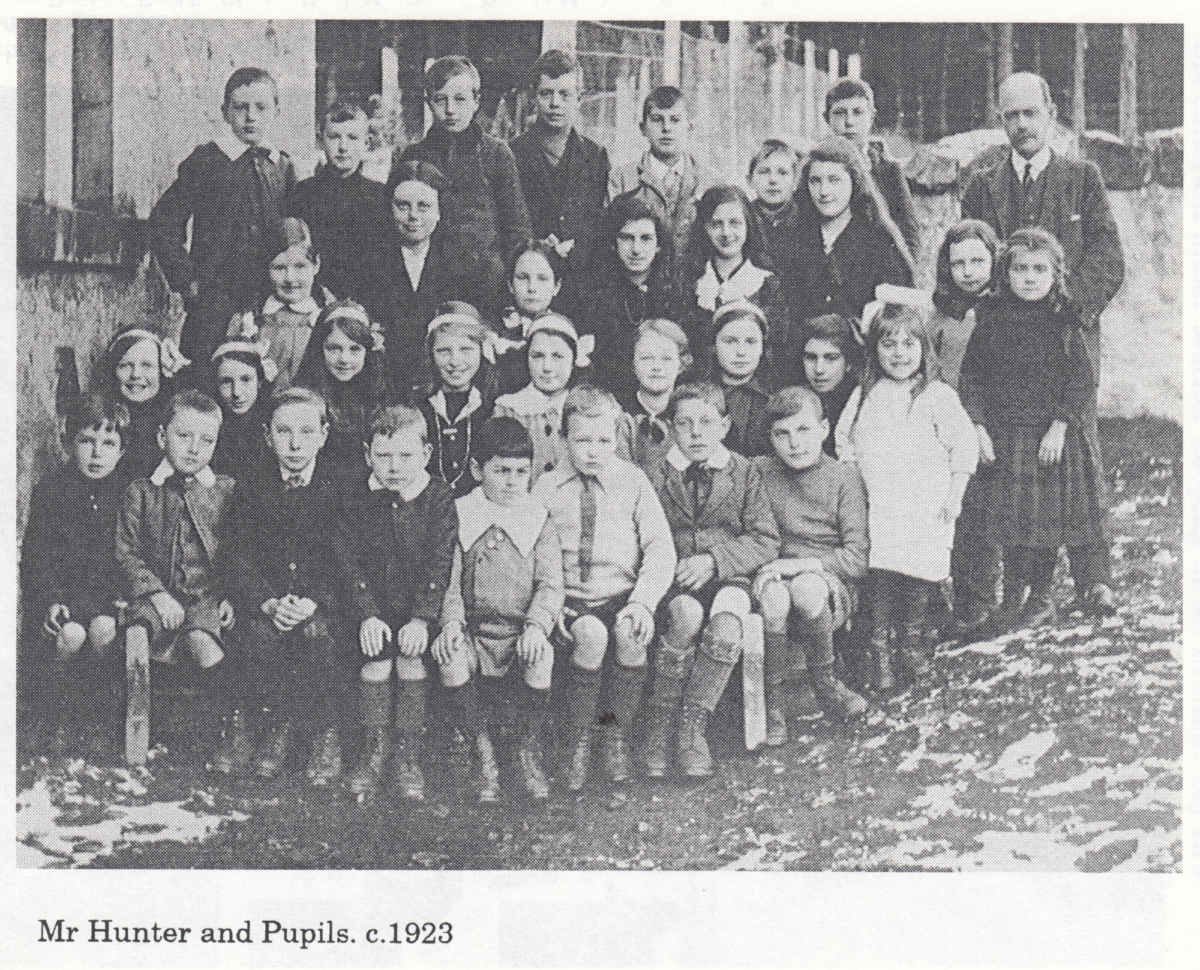
He was followed by a Mr Cooper, of whom we know little but we understand that he died in the schoolhouse there in 1899, and then our teacher came, Mr John Hunter, and a great teacher he proved to be. Discipline was exacted and we owe him much.”
Miss Dunbar started school in 1915 and left in 1923 to attend the Inverness Royal Academy; her brother started in 1916 and left in 1924, to go home to “plough and sow, and reap and mow, and be a farmer’s boy”.
“Up until 1924, Mr Hunter was the sole teacher there until a Miss Calder came to take charge of the primary pupils. There would have been around thirty pupils in all, and all at different stages. The numbers varied. Mr Hunter retired in 1926.
We enjoyed our schooldays, and in the winter months we had great fun sledging and sliding. We had weeks sometimes of deep snow and frost, and I remember once the snow was so deep that we went by horse and sledge. In the winter months we enjoyed our mugs of hot cocoa which was kindly supplied by The Mackintosh, prepared in the schoolhouse and served by Mr Hunter.
It was wartime 1914 – 1918 and we remember the older pupils being sent out on occasions to gather sphagnum moss, which was dried on the fences and then packed in bags and sent to the military hospitals, where it was used instead of cotton wool to cover the dressings of the wounded.
We used to have sewing and knitting periods twice weekly, supervised by Mrs Hunter, while the boys were sent out to the school garden, to weed, etc.
At an earlier date, when the older members of the family were at school, there was a near tragedy, when one of the girls fell into the marshy loch on the moor while stretching for water lillies which grew at the edges – the other girls fled, while one brave lass grabbed hold of her companion, thus saving her life. I trust to-day’s schoolchildren will not be so reckless as to go near that spot.”
Pearl Cameron tells of life in and out of school in the early thirties:-
As I think back on my childhood days in Moy I find that thousands of memories crowd in and out of my mind and as I pick up my pen to try to write some down, I am quite at a loss to know where to begin. “Of course,” I say, “begin at the beginning”.
As I was only 1½ years when I came I can’t remember anything of that, but I do believe the Old Manse seemed huge and empty, in a dreich November day and probably rather forbidding to a young couple who had come from a small farm cottage in Munlochy, the furniture from which just about got lost in one room at Moy.
I well remember feeling very scrubbed and shiny and a bit apprehensive when Danny Mackenzie’s younger sister Annie called to take me to school; she had already walked two miles from Ballachlodich but school went in at ten then. We were summoned by a few loud blasts on a whistle and had to line up at the door to await the word to march, into school, past the teachers. Every girl had to make a little bow of the head and the boys saluted. The school at that time was divided by a big heavy green curtain – wool or tweed, I think, – into two rooms known as the “big ones’ ” room and the “wee ones’ “. There was a coal fire at one end, the far end, to which the headmaster turned his back and bounced up and down on tiptoe while he talked, holding tightly to his massive plus fours, either to stop them from catching fire or perhaps to spread the heat. This man Kenneth MacLean wasn’t extra tall but had he been six feet tall he’d still have looked broad. I enjoyed his teaching very much, he was great, but I hated going out to his desk with my work as I felt a bit ill when I got a close-up of so many long hairs that grew out of his nose and ears. Funny! the things that register and stick in your mind at that age.
From the age of five to ten you stayed in the wee ones’ side with a lady teacher; this side was heated by a round Valor paraffin heater and I can picture at least ten pairs of purple and red hands twirling and rubbing above the wee stove at interval time. We had a very varied and interesting schooling. A typical day would be “Bible”, perhaps a short reading or repeating verses of a psalm which we would have memorised the night before or while walking along the road to school, bible in hand, sometimes it was catechism, followed always by the Lord’s Prayer. This would be followed by, in turns, Reading aloud from reading books with lists of meanings at the back of the books, which we also had to prepare the night before, Arithmetic, Copy Books, English, silent reading with a good choice of books, Gym, Gardening, Nature Study, Singing etc. You could stay at Moy Primary till fourteen or do a wee exam to get into Inverness Royal Academy at twelve years
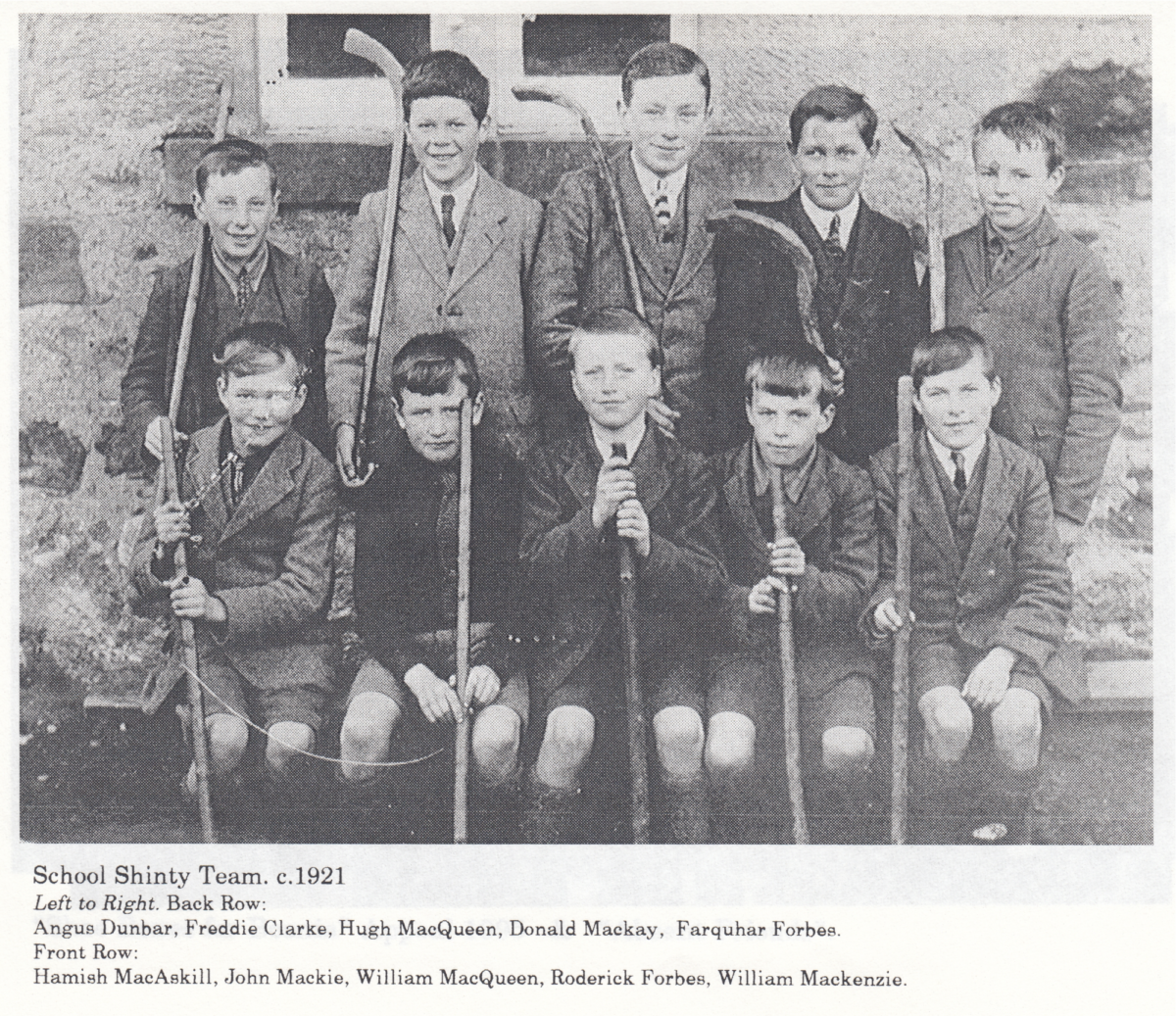
We all took a “piece” to have for lunch and very often ate it all at eleven. In summer, when we had an hour for lunch we stayed ½ an hour later and then I ran home for my lunch, but in a way I rathered stay at school to play cowboys and Indians, or shinty etc or ten stonies or hopscotch or skipping or kick the can.
On hot days, on our way home, we often sat on the road to burst the tar bubbles with our toes, getting up when we heard a car coming and, after it went past, resuming our game till the next one came, if any did; Sheriff Grant went once a week. We spent ages “posting” fir cones down a wooden chute set to carry water away from a drain on the roadside or playing in the lovely Burnett’s Burn. I never knew who Burnett was but I always remember the milestone there said 103 miles to Perth and 12 to Inverness. The wood that stretched from this burn, near the church, to Tullochclury was known as the Black Wood and consisted of old, very tall, Scots Pines with most of the foliage growing at the top of the long straight trunks. This meant there was plenty of room to play below, where grew heather, blaeberries and cranberries etc. and many lovely rowan and birch trees. You could clearly see the loch and islands from the roadside then. Once a cormorant hatched chicks on the small island and the male could be seen, every day, standing still like a sentinel on guard while his mate sat on the nest.
It was a great day when I was considered old enough to go to fetch the milk from the dairy at Moy Mains. The MacAskill family from Moybeg took turns of going and I always went with one of them. In the Summer we walked round the Tower road but, in Winter, when The Mackintosh lived in Wales, we chanced to go by Moy Hall driveway. We took a short cut over the wall by the roadside near home, down a path and over the turbine burn which took us on to the drive by Greta’s, Morrison’s in those days.
The drive was hedged by great old Spruce trees, so dense that nothing grew; below the trees’s spread a thick carpet of Is dead needles. On dark nights one could not see the road at all, just wandered on guided by a narrow strip of dim grey sky or starlight where the trees did not quite meet. We were never scared of the dark and never saw the Green Lady; we didn’t want to refuse to go for the milk or try to dodge the job, it was great fun. When we reached age of seven but couldn’t reach the seat, we were allowed to use our mother’s bike, a 1930 Raleigh model, and then began the harassment of the carbide lamp which flared into brightness one second and then, when you turned the water off a bit, sank into a peep no bigger than a dying match, leaving you unable to see a thing till your eyes got accustomed and undazzled.
We usually arrived early so we put our pails on the dairy window-ledge and ran down to the byre, which was on the right of the fold; the stable was on the left. We had to whisper once we reached the square as Sarah, the dairymaid, ran the whole thing like a military operation. She was a white-haired, spick and span wee lady from Greenock, always wore a pure white apron and was a real tyrant. We were only allowed to watch if we kept really quiet and still, in case we disturbed the cows, who had their names above each stall, painted on a little board. When I think of it, they had mostly flower names, Like Daisy, Buttercup, Marigold, Violet. Sarah’s husband Alex was a very quiet, smiling man, tall and slightly bent, and they both used scrubbed stools to sit on when they milked the cows by hand (I forgot to say that the cows’ udders were gently washed from a small bucket of liquid and a very clean muslin cloth). The milk was then poured through butter muslin on a sieve and as soon as the sieve was removed there was a lid at the ready, thus making sure that the milk was really clean. Inside the dairy there were sort of slate shelves all around the wall on which were placed some large basins, 21/2 to 3 feet in diameter and after our milk was all dished out the remainder was poured into these basins so the cream could “set”, to be poured off, later, for butter-making. The skimmed milk, known as “cold” milk, could be bought at 3 or 4 pints for 2d. Great for drinking, making rice puddings or pancakes. The floor of the dairy was black and white tiles with a beautiful churn standing in the middle, all brass trimmed.
As we set off for home we always watched the ploughman “louse” the horses. They were great big Clydesdales and they clomp clomped over the cobbles to the water trough and then into the stable for a lovely feed of bruised oats which were put into a smallish wooden box fitted on the manger at the head of the stall. I always remember wishing and desperately wishing for a “shot” on the back of one of the horses, but there were no offers. If it was dark we would creep up to the stable and peep at the hallowed place, safe in the knowledge that the lantern light wouldn’t reach us to show us up. It was lovely to listen to the slow contented munching sound, to picture their huge lovely velvet noses collecting their well-earned tea and to know that they would all have a lovely warm rest, to fit them for to-morrow’s hard graft in the fields.
We went off round by the cartshed which also housed some pale-wagons, past the bell by the Bothy which has the amazing date 1281 on it and then made for home.
There were lots of grown-ups who came to fetch milk too, and to chat, I think, was the main object. They always joked with us children and “pulled our legs” a bit I am sure. They usually had a sweetie or two on offer as well.
They are all there, a host of ghostly memories. Mr Clarke the butler who lived in Moy More house, tall and regal and very benign, with quite rosy cheeks. Dan Seath and his wife – The Kennels; he was a keeper and his voice was like a low grating bark. I was a bit scared of him but I’m sure he was fine. There was Greta’s father Walter Grant who was a cheery bustling man with quite a big kind of paint-brush moustache; he walked very fast and had a funny wee cough which might have been a giggle. On telling anyone off he scratched his hollow cheek and said, “You require to be careful”. Gardeners John Mackenzie and Tom Hare – a wee Irishman with a club foot – some jobbing gardeners who lived in the Bothy beside the Bell, Morrison the chauffeur, the Maylems who were Mrs Danny’s folk in Railway Cottages, also Frasers – the Tacketts. Paterson the Stationmaster had a large family. Sandy MacIntosh, Forester, lived at Moybeg, Tom Fraser, Forester; MacAskills, Moybeg – MacAskill himself was known as the Strathdearn Bard – a large family too. Lynemore was Danny Mac, there were Rosses next door to us, not forgetting the Reading Room and the post’s and piper’s houses near the Old Inn and the Old Smiddy, with a sawmill powered by water across the railway. The piper had a pink face and wee glasses, pure white knees which showed below the kilt like two wee sticks – he walked like that too. He was a nice man and always had a joke. He played reveille – “Hey Johnny Cope” – every morning below the Moy Hall windows and I don’t know if he did anything else. The Frasers from Moybeg cottage, neighbours of Grants. Finlay had the most turned-up toes on his tackety boots and often talked about his “Greams” (dreams). Ballachlodich had Nicholson – shepherd from Skye – and wee Jocky Thomson – who gave us Domino chocolate – as well as Mackenzie, The Grieve.
Back to the dairy for a sec. The wives all came when the men were busy and what a lovely picture they made with their long revered suits and lovely coloured blouses, beads and nearly always a hat. I got a job delivering milk to Moy Hall before I went home with my own, of course it was only across the road and I got 10d for four nights – quite a pile of pennies.
We usually slipped up a wee path past the curling house and out at monument hill and if we heard the 5.50 train we knew we’d wasted far too much time and we’d better hurry the rest of the way.
It was such a lovely care-free childhood and we learned to know every stick and stone of the place. It would fill a book to tell about all the laughs and fun and pieces & jam (reward for jobs) and to try to describe our feelings for all the animals and birds with whom we shared our beloved corner of Scotland.
Thirty years on Louisa Cross (nee Mackintosh of Mackintosh) adds her snippets of memories of the five years she spent at Moy Primary from 1967 to 1972:-
That first day of my career at “Moy P”, my first lesson was that the boys went in the blue door and the girls went in the pink door of the cloakrooms. I was very impressed by the drinking water fountain inside the girls’ door! I also learned that I was one of the “Wee Ones” and not nearly as important as the “Big Ones” in P6 and P7! In the mornings we had to drink a plastic carton of milk – either warm in summer or full of ice blocks in winter. As I was one of the few girls, I became a bit of a tomboy and felt very angry that I wasn’t allowed to wear trousers to school. One morning, I managed to rip two pairs of woollly tights at the knees in a bid to be allowed to wear trousers – but I did not get my own way!
Morning classes consisted of reading Dick and Dora’s adventures with Fluff the cat and Nip the dog, or working our way through whichever maths book we had reached in the series. Afternoon classes were history, geography or, on Friday afternoons, knitting for the boys and the girls! I still have the green and white scarf which I knitted before I realised that I had knitted the colours of the dreaded Celtic! In the Christmas term we spent many afternoons preparing masks for the guising at Hallowe’en. I still haven’t had the heart to throw out the tiger mask – now rather battered -which I made all those years ago! As soon as Hallowe’en had passed we started looking forward to Christmas and the Christmas party. The basic elements of toilet rolls, egg boxes, clothes pegs and crepe paper glued together with silver dust, gold stars and wax crayons formed many a table or tree decoration. In P1 and P2 we had great fun completing coloured sticky paper chains to hang round the classroom and our own homes.
I remember playtimes running round the tarmac playground playing “Foxy Round the Shelter” and football. I was very proud the day I dared to tackle one of the “Big Boys”- “Cheesy” Chisholm – even though I was not successful! It was important to support either Celtic or Rangers – I supported Rangers mainly because I preferred blue to green but I didn’t tell that to the “Big Boys”! Some of our other games were “Kick the Can” and “Hopscotch”, with the squares drawn in chalk on the tarmac playground. I was very envious of the children who were given golden syrup sandwiches for their playpieces! For all my football practice, my sporting talents never really developed. In fact my sister Anne and I were the only ones who didn’t win a ribbon for 1st, 2nd or 3rd place in any of the races at Brin School Sports! At dinner time we all sat round the long rectangular table at the end of the classroom, while Mrs Birnie ladled out whatever had been delivered in the large metal urns. The vegetables had usually suffered from their journey in the urns but we had to eat them anyway. As for the puddings, I hated sago and loved the sponge puddings with syrup!
In the summer time, we used to play in the woods behind the playground where we built a small den from old branches. I remember one summer, David MacQueen, Barbara Ross and I sneaked down to the forestry hide by the side of the loch a big adventure and not allowed! In the late summer, there were hundreds of blaeberry bushes which we were not supposed to pick. However, the juicy berries were too good to resist. What we did not bargain for was the teacher spotting our purple faces as we sneaked back into the classroom after playtime! When the roadworkers were building the new A9 (now even that section is the “old A9”) behind the school playground, the trees in the woods were cut down and we were all fascinated by the JCBs cutting their way through the ground. The summer term was when the purple lupins by the school brae came out and I remember sitting by them waiting for Mum and Dad to come to take me home. On sunny afternoons, “the teacher” (Miss Cuthbert) took us for nature rambles down to the forestry to learn about the wild flowers and animals of the country. One afternoon, the Forestry Commission took us to see where they were planting trees and gave us each a seedling to plant. My sister, Anne, and I were given a sitka spruce each which we planted in front of Moy Hall.
Other hot summer afternoons were spent in the teacher’s garden taking a survey of traffic going by on the old A9. This was my first experience of bar gates for counting – and of how to get a sun tan!
The highlight of the summer term was the school trip with Tomatin and Daviot Primary schools. The “Big Ones” went off on the trips while the “Wee Ones” went to have classes with either Tomatin or Daviot school that day. My most memorable trips were to Aviemore Centre. We drove the children’s go karts and went swimming. It was big excitement to have a day out and a bus trip – and also to buy sweet cigarettes and funny face ice creams from the shop!
We all took part in the school concerts, with Mrs Pitblado, the itinerant music teacher keeping us all in tune. My first starring role was “Fresh Air”, with Christine MacLean – my only classmate for 2 years until she moved with her family, including brothers James and Robert, to the Black Isle – as “Exercise”. The school choir (the whole school in our case) once won a prize at a schools competition staged at Millburn in Inverness.
All these were happy memories of a very special school. Here’s to the next hundred years!
The present generation clearly shares the opinions of its predecessors, though it is allowed less leisure in which to think and write about them. Amy MacQueen, Dalmagarry, is brief and to the point:-
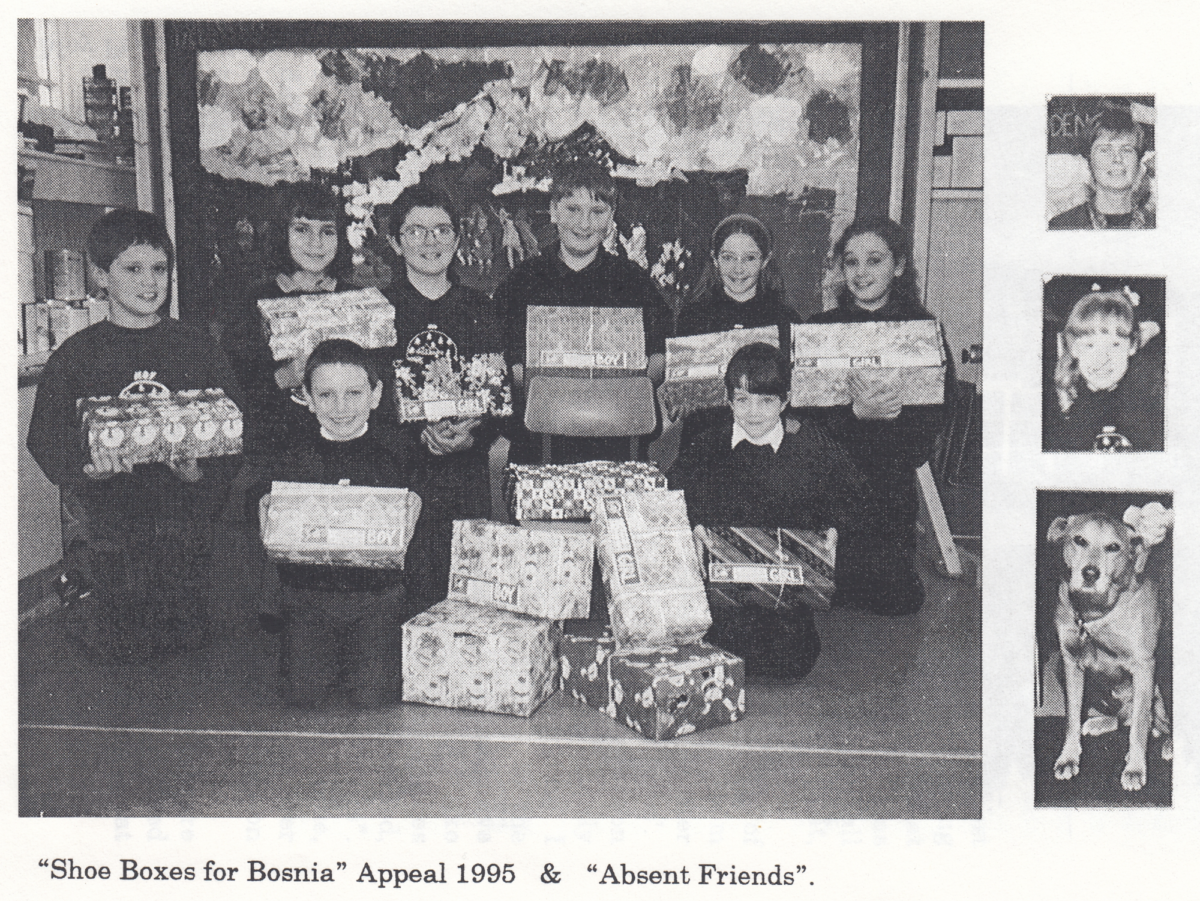
In 1996 Moy School has only got 9 pupils. Our teacher is called Mrs Reid-Evans. We do maths, language and science as well as printing things on the Computer. We can send messages to other schools through a modem joined on to our computer. Specialist teachers come to the school to teach us Art and Music. The Music teacher also teaches us to play the recorder. As the school is still the same size as it was 100 years ago and has no hall we join with Daviot P.S. for P.E. each week. 3 of us go to swimming lessons each Monday in Inverness. They are fun. We take the teacher’s dog a walk after lunch. I enjoy school and think the teacher is imaginative because of all the dances and actions she thinks up for our drama productions.
FRIDAY, 17th MAY, 1996.
Centenaries do not come every week, indeed, for most people, they do not come at all, so a centenary is something to make a song and dance about. A song was about all that Moy School did not make over its centenary; there was entertainment, an exhibition, enough food to give a small boy (or a small girl, for that matter) pause for thought, music and dancing.
Entertainment came first, with parallel performances of the school’s very own version of Macbeth in the schoolroom and a show by “Mr Magic” in the playground shelter, after which the audiences changed places for the ‘second houses’.
Macbeth was no multi-thousand pound production supported by lavish grants but it was a tremendously smooth, if uncomplicated, performance by the cast of nine. I do not think that the Bard would have objected to the liberties taken with his script and I am sure he would have enjoyed the jokes. One that roused what seemed like nostalgic appreciation was when Macbeth asked the witches what their brew of ‘eye of newt, toe of frog’ etc. was called, and received the eldritch answer “school dinners”. Perhaps the highlight though, was the final battle scene, difficult enough with a cast of nine, but brilliantly put over as a dance routine. Moy School’s Macbeth should go on tour, but it should come back frequently.
Probably, the conjuring tricks in the shelter were simple, but they looked pretty difficult to me. A polished performance, plenty of audience participation and great fun.
Food came next. In the morning, the schoolroom appeared to be occupied by a multitude of carrier-bags containing sliced bread but by the evening all these had been transformed into plates and plates of sandwiches of all kinds. Then there were plain cakes, iced cakes, chocolate cakes and biscuits and it was all laid out, with tea and coffee and soft drinks in a long tent on the lawn in front of the school. Plenty for all and more, but there was method in it as well, for while the spectators were occupied, Macbeth’s castle was turned round and sundry blasted heaths and battlefields were adjusted to reveal an exhibition of Moy, not exactly through the ages, but from the time of the first Ordnance Survey map in 1872, before the railway came. Through maps, school registers, the stories of former pupils, photographs and exhibits, some of general interest (which included such evocative items as a slate and slate pencil and a tawse of such megaton proportions that it can only have been intended as the ultimate deterrent) and others referring to particular happenings, we could follow the fortunes of Moy and its school through two World Wars, the demise of the railway, the diminution of the Moy Hall estate and the depopulation of the countryside that these events brought. An altogether worthy effort deserving of a more permanent setting.
After the exhibition, dancing in the playground to a small band. Although the date had been chosen with some care, with a view to the weather being suitable for people and unsuitable for midges, the evening turned out to be a typical Strathdearn non-spring one, quite cold enough to encourage dancing if only to keep the circulation going.
Friday, May 17th 1996, was a splendid evening of
celebration and memory, made possible by the
unstinting work of all concerned:-
The Cast of Macbeth,
Ably directed by Mrs Reid-Evans and Mrs MacDonald, Mr Magic,
The Band,
Ross Fraser, who made the Centenary Birthday Cake,
Forestry Enterprise, who supplied the tree-trunks for seating around the playground.
A large supporting cast of sandwich makers, cake bakers, tea pourers and tent-erectors and -dismantlers.
And, I am sure, many others behind the scenes.
I sincerely hope that this little book will, as forecast by the Chairman of the School Board, provide a lasting reminder of happy years, and a happy evening of celebration. My thanks are due to all those who have helped and encouraged me to produce it.
J.S. June 1996.