
A core role for Strathdearn Community Council is to ascertain community views and make representations to Scottish Ministers, Highland Council and other public bodies, on the interests of its community.
Environmental Impact Assessment (EIA) is a process that identifies the potential environmental effects (both positive and negative) of a proposed development and demonstrates how the developer will prevent, reduce, and mitigate adverse effects.
Developers must submit a Scoping Report, requesting a Scoping Opinion which assesses each of the EIA criteria to be further assessed and included in the final EIA report which accompanies the application. Once formally submitted, the full EIA allows consultees to consider if the proposed development is or is not acceptable and if planned mitigation would be appropriate and achievable.
For community views on the scope of the EIA, Strathdearn Community Council needs to gather them. Your views on what should be included in the full EIA are important, but they are only the first part of our consultation process. If you are a Strathdearn resident, please mark your view in the 4 proposals below.
A summary of each EIA is attached.
Please click/tap the submit button above when you have completed the survey. What follows below is detailed information and maps for each proposed windfarm.
Highland Wind Farm
Clune Windfarm
Balnespick Wind Farm
Lynemore Wind Farm
Highland Wind Farm
| Name | Highland Wind Farm 24/01107/SCOP – Ampyr and ESB |
| Application | A potential Section 36 application to Scottish Ministers under the Electricity Act 1989 to construct and operate a Wind Farm. The grid connection will be subject to a separate application under Section 37 of the Electricity Act 1989. |
| Status | EIA Regulations Scoping Report submitted for consultation March 2024 24/01049/PAN (Proposal of Application Notice) was submitted by the developer in March 2024. It is not a planning application but a notice advising of how the developer intends to engage with the community about their proposal. |
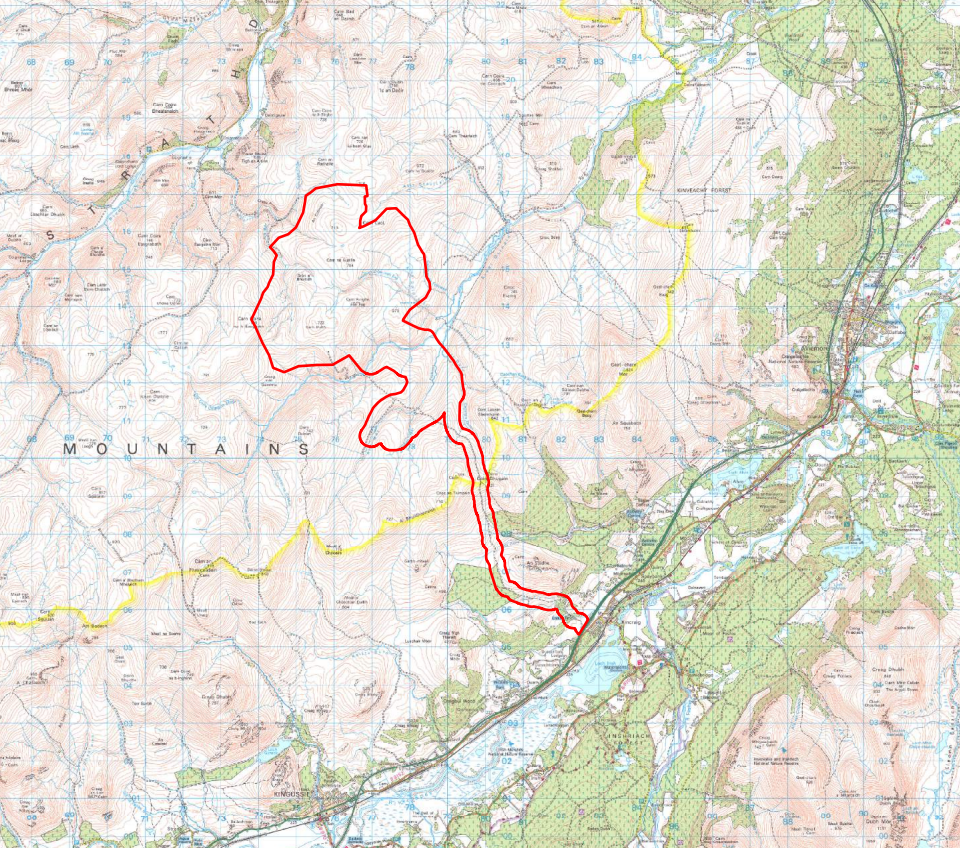
| Location | Approximately 4.2 km west of Aviemore on Dalmigavie, Dunachton and Alvie Estates, with the turbines located on open upland peatland and montane habitats in the upper reaches of the River Dulnain and the River Findhorn within the designated Monadhliath Wild Land Area. |
| Description | A 24 turbine (200- 230m to tip) wind farm with associated 30 MW battery energy storage, substation, access tracks, crane hard standings, turbine foundations, borrow pits, temporary construction compounds, wind measurement mast, communications mast, and underground cabling over a 2,940-hectare site. It will be accessed from within the Cairngorms National Park off the A9 at Kincraig and export its power across the Findhorn to the substation at Garbole. Construction will be about 2 years and the operational phase is indicated as about 40 years. At the end of the operational life, the wind farm would be decommissioned or extended or repowered |
Clune Wind Farm
| Name | Clune Wind Farm 24/00690/SCOP – RES |
| Application | A potential Section 36 application to Scottish Ministers under the Electricity Act 1989 to construct and operate a Wind Farm. The grid connection will be subject to a separate application under Section 37 of the Electricity Act 1989. |
| Status | EIA Regulations Scoping Report submitted for consultation |
| Location | The Site is located on Clune Estate on elevated open moorland, located approximately 3km south of Tomatin. The highest point is 750m, at Carn Dubh’Ic an Deoir. The site is divided by four burns that flow north into the River Findhorn: Allt Phris, Clune Burn, Allt Lathach, and Wester Strathnoon Burn. |
| Description | Erection and operation of 27 wind turbines with a maximum blade tip height of 200m, with associated battery energy storage, voltage transformers and related switch gear, substation, access tracks, crane hard standings, turbine foundations, borrow pits, temporary construction compounds, communications mast, and underground cabling and ancillary infrastructure. It will be accessed from the A9 and over the Highland Mainline on the U2856 (Slochd – Tomatin road) with a new priority access junction and export its power across the Findhorn to the substation at Garbole. Construction will be about 2 years and the operational phase is indicated as about 40 years. At the end of the operational life, the wind farm would be decommissioned or extended or repowered |

Balnespick Wind Farm
| Name | Balnespick Wind Farm 23/04199/SCOP Fred. Olsen Renewables |
| Application | A potential Section 36 application to Scottish Ministers under the Electricity Act 1989 to construct and operate a Wind Farm. The grid connection will require a separate application under Section 37 of the Electricity Act 1989. |
| Status | EIA Regulations Scoping Report submitted for consultation August 2023 |
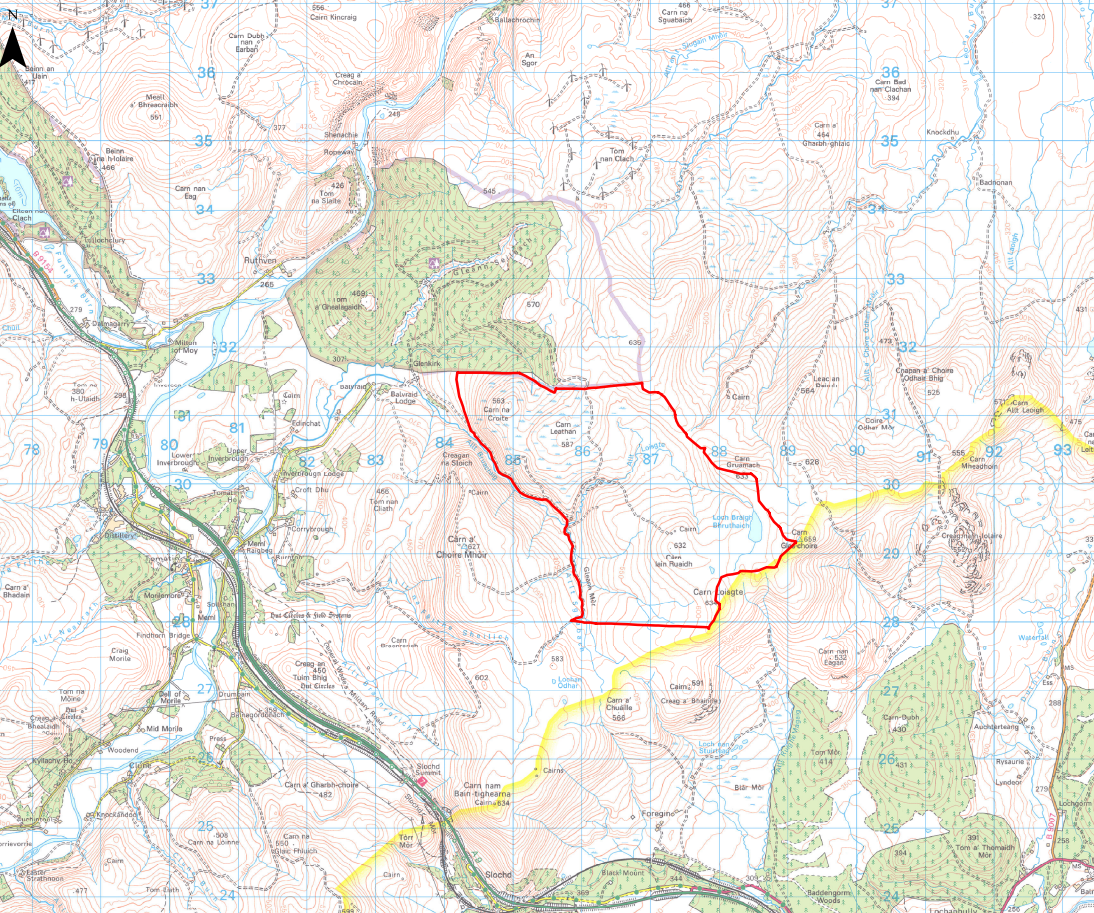
| Location | The site is located approximately 5 km east of Tomatin and 6 km north-west of Carrbridge. The site is approximately 1,020 ha of upland moorland, currently managed as a sporting estate. There are two hill features, separated by the Allt Loisgte. A previous 26-turbine proposal for Balnespick, by developers Eurus Energy UK Limited, was rejected in 2013. |
| Description | The proposed development is anticipated to comprise approximately 9 wind turbines with a tip height of up to 200 m. The associated infrastructure will include site access, crane hardstanding’s and laydown areas, underground cabling, an on-site substation, battery energy storage system, external transformers, temporary construction compound, potential excavations/borrow workings, and a meteorological mast. It will be accessed from the Dava road using the first park of the Tom nan Clach wind farm access. Grid connection will be across the Upper Findhorn to the Garbole substation. Construction will be about 2 years and the operational phase is indicated as about 40 years. At the end of the operational life, the wind farm would be decommissioned or extended or repowered |
Lynemore Wind Farm
| Name | Lynemore Wind Farm Galileo Empower UK Ltd |
| Application | A potential Section 36 application to Scottish Ministers under the Electricity Act 1989 to construct and operate a Wind Farm. The grid connection will require a separate application under Section 37 of the Electricity Act 1989. |
| Status | EIA Regulations Scoping Report submitted for consultation |
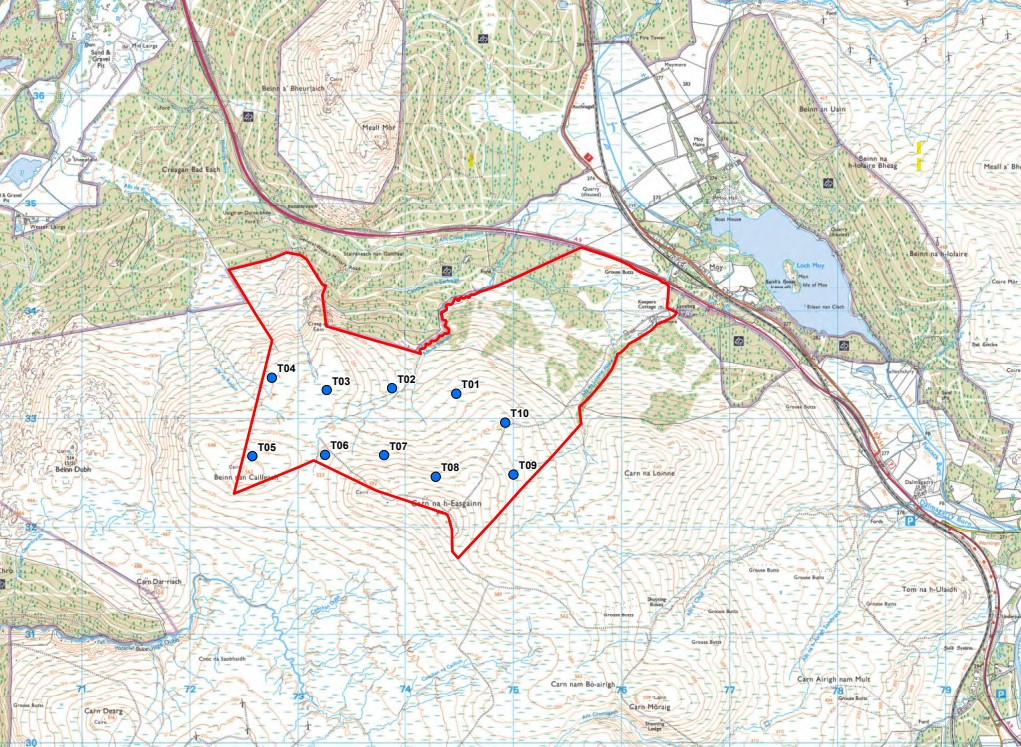
| Location | On Lynemore Estate on the hills 2 km west of the A9 at Moy, the site is mostly open moorland, managed primarily for field sport. Carn na h-Easgainn (616m) is located within the southern edge of the site boundary. Areas of open deciduous woodland and commercial plantation lie to the north of the Site. The Farr/ Glen Kyllachy Wind Farm complex lies approximately 2km to the southwest of the Site. |
| Description | It is anticipated that the Proposed Development will comprise up to ten wind turbines, with a blade tip height of up to 200 m, Battery Energy Storage, associated infrastructure, and ancillary development. The total installed capacity of the Proposed Development is expected to be over 50 MW. The Proposed Development will also introduce appropriate, site-specific measures to conserve, restore, and enhance biodiversity, in accordance with national and local guidance. Grid connection and possibly access from the A9 Alt na Slannach haul road junction will be to the Garbole substation through the Farr/Glen Kyllachy Wind Farms. Construction will be about 2 years and the operational phase is indicated as about 40 years. At the end of the operational life, the wind farm would be decommissioned or extended or repowered |
Factors you may like to consider.
| Some possible significant effects and adverse impacts that may not be sufficiently mitigated or don’t outweigh benefits leading to disagreement with the EIA proposals | Industrialisation of a semi -natural moorland area and loss of habitat Cumulative effects and extent of existing wind farm in the area – Farr, Glen Kyllachy, Dumnaglas, Moy, Tom nan Clach and pylon provisions Knocknagael – Garbole 275kV Beauly to Boat of Garten 132kV Insufficient space between current and proposed developments contributing to coalescence. Visual and landscape impact for residents and visitors (plus possible lighting and noise issues) and A9/railway as tourism corridor Disturbance to local wildlife Surface water flow, drainage and water ecology Cultural setting impacts – eg on B listed Dalarossie Church and Burial Ground |
| Some possible significant effects and benefits that probably outweigh negatives leading to agreement with the EIA proposals | Contribution to progressing towards a Net Zero GHG emissions target by 2045 and addressing the climate emergency Reducing dependence on UK energy strategy linked to other nations Prospect of the people in Strathdearn receiving community benefit and/or the option of shared ownership Jobs and employment for local contractors and local economic uplift to landowners and others |
Factors Scottish Ministers are likely to weigh up in their final decisions on the four EIAs.
- Policies in the Scottish Government’s primary planning document NPF4, approved in 2023, explain that
- Renewable energy development is “fundamental to achieving a net zero economy”
- Development proposals will only be supported where they maximise net economic impact, including local and community socio-economic benefits such as employment, associated business and supply chain opportunities.
- Development proposals that will affect a National Park will only be supported where the overall integrity of the area will not be compromised or any significant adverse effects on the qualities for which the area has been designated are clearly outweighed by social, environmental or economic benefits of national importance.
- impacts on communities and individual dwellings, including, residential amenity and visual impact
- impacts on adjacent trunk roads
- Locations in Monadhliath have been identified as suitable for wind power generation and are expected to be suitable for use in perpetuity
- Cairngorms National Park benefits are considered to extend beyond the boundary
- Existing Garbole sub station with capacity to accept grid connections
- Proximity to A9 and Inverness port for delivery of turbines
- Any adverse impacts which could not be mitigated without significantly altering the design and positioning of the proposed wind farm
- SSEN have a duty under Section 9 of the Electricity Act 1989 to facilitate competition in the generation and supply of electricity which means pylons/cables and sub stations for connection to the transmission system, both for new generation and for new sources of electricity demand.


