INDEX of Ann Glynne-Percy Essays
North Side of the River
The waters of the Findhorn arise from springs in a boggy plateau in Am Monadhliadh – the grey hills – although the main source reputedly flows from a cloven stone. Two streams, the Eskin and the Abhainn Cro Clach, meet beyond the bothy at Dalbeg to become the Findhorn, and the strath widens to become habitable beside the river.
Coignafearn Lodge is the furthest dwelling up the Glen, with a large sporting estate. The Coigs area was known as Schiphen, or abode of peace; also the Braes, although some humourist was quoted as saying that with the poor soil the peat stacks were bigger than the cornyards.
The Coigs, however, must have been more fertile, as the late Maggie Mackenzie remembered nine families living there, but all gone now. The name means a ‘fifth’ – Coignafearn is the fifth of the alders, the wood being valued for the making of clogs in the past. Coignafunternach is the fifth of the rank grass (?) or metal workers, a smithy (?) Coignascallon is the fifth of the huts or tents. Coignashie the fifth of the fairies, and Coignamullin is the fifth of the mill. The latter was particularly interesting to explore as one could trace where the mill lade had been diverted from the burn, and the sluice, and it was away from the plantation of spruce trees which had engulfed some of the other buildings. It was quite eerie walking through the silent wood, and suddenly coming upon the ruins of a house, especially as there were numerous animal bones on the ground, remains of foxes’ bygone feasting.
In 1878 Alex Macbean, alias Michal of Coignafunternach, died aged 94. He was greatly esteemed for his piety and convictions. He had been a drover in his youth, and paid rent for 78 years, walking from where his ancestors had farmed to Moy Inn on rent days, active to the last. The Mackintosh of Mackintosh was present at his burial at Dalarossie.
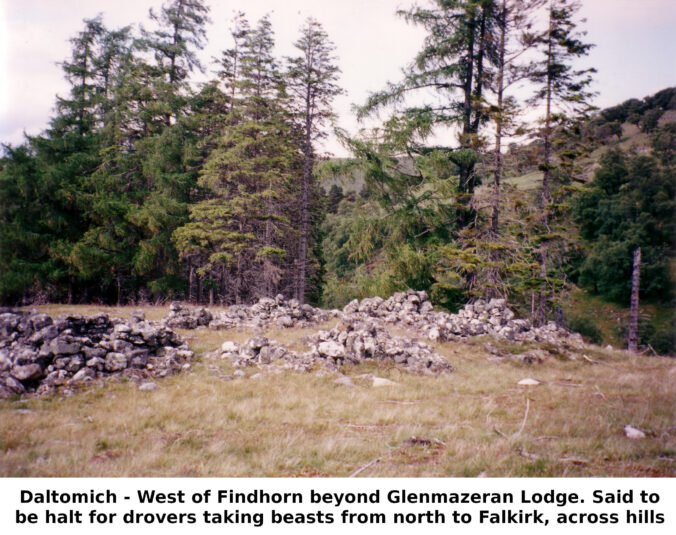
Following the road by the river, Daltomich is on the left. The ruins nearby were said to be an Inn or resting place for drovers herding their beasts south across the hills towards the Lowlands. In 1868 there was a post runner from Tomatin to Daltomich once a week, the Post Office paying, and the people of the district paying twice a week. Such was the benefit of the service, they were willing to pay for the runner thrice a week.
The next dwellings are Laggan and Kilrain, a wonderful place to see red deer feeding peacefully, overlooked by Glenmazeran Lodge. One house nearby was the old Post Office and apparently an illicit still was once found in a chimney, when it was being renovated.
Glenkyllachy is also to the left of the road, further on. There was supposedly a ‘castle’ or dun nearby, but the most likely place for a fortification or place of refuge would seem to be the Tor, overlooking the Lodge. There is an impressive vista of the Strath in all directions, and rocks at the summit appear to have formed walls in places, some possibly vitrified.
Next on the right is Norwood, a beautiful timber built house, then Garbole and Asgard, across the way. The side road signed Farr leads over moorland to Strathnairn, passing an active windfarm. The road then crosses the Glenkyllachy burn by an attractive hump-backed bridge. There had been a mill upstream and faint remains can still be seen, including a portion of millstone by the overgrown sluice, and foundations of buildings. A Lewis Rose worked the mealmill before the turn of the 19th century. He later moved to Milton, Moy. Mrs Rose kept a general store at the roadside between Garbole bridge and Corrievorrie, but no sign of it now; maybe the site was at the present keeper’s house.
Dalarossie Church and its ancient graveyard can now be seen to the right, across a field and by a sharp bend in the river. As you approach you cannot but be struck by the special feeling this old site of worship engenders. Recently I walked round the building and was touched to see a sturdy nest of mud built above one of the windows, and the words of Hymn 4 came to mind – “the swallow for herself hath purchased a nest …. and young ones safe brought forth” – though I think it was a house martin family.
Many years ago it was the custom for a game of shinty to be played in the glebe on Christmas Day, unless it fell on the Sabbath. However, the men of Clan Ay (Shaw) from Strathnairn challenged the local lads nonetheless, but they declined to take part, so the others made two teams amongst themselves. Divine vengeance came upon them, and within a year all were victims of a fell disease and died. It is said that whoever passes Dalarossie on a Sunday Christmas Night may see their phantoms playing yet.
There was a school near Dalarossie, remembered by Betty Watson and Alex Don who were once pupils, but it is much altered now. The next farm cottage along the road, Corrievorrie, has been rebuilt very attractively. Old maps show the sites of Breckeriemor and Breckeriebeg on the ridge above, also Ardachie. It was farmed by Macdonalds, and a daughter, Janet, married Angus Maclean the Shoemaker, who lived at Morile in the 1800s.
Further down the road, near the river, is Auchantoul, the main farmhouse for Kyllachy Estate, but it has been totally reconstructed, along with its neighbour, Wester Auchantoul, though in sympathetic style. Kyllachy House is hidden from sight, above the road, with a handsome beech hedge, but drivers go by with caution as there are awkward bends on the brae and one might meet a minibus full of eager birdwatchers heading for Coignafearn in the hopes of seeing golden eagles or other rarities.
There are numerous lime kilns in the Strath and I often wondered where the raw material actually came from, until I saw one quarry near Kyllachy – the place of the grouse cocks. The workings are overgrown but one could picture what toil it must have been to hack the lime free and cart it away, long before the days of JCBs and tractors. One pleasantly non-industrial memory of the rugged site was the number of wild strawberry plants growing there.
Wester and Easter Woodend are further on, to the right. Ordnance Survey maps show the existence of prehistoric cairns and settlements on the slopes above, along with field systems, but I’ve never walked there. Dell Farm is off to the right, near the river, and is now the site of a thriving wood processing venture.
Near Easter Midmorile there used to be a wooden house, known as Rose Cottage, but it came to a dramatic end when it was burnt down as a fiery chapter in the making of the TV series “Maggie,” in the early 1980s. At the entrance to Midmorile there is an old cottage by the roadside, totally basic, with a corrugated iron roof. One could imagine an estate agent describing it as “having great potential,” as well as a grand view! I believe the Storey family were the last occupants. Mr Storey wrote articles for local newspapers, including one about my wedding in 1951!
Bridgend was a busy community of its own, with three houses, one known as the Poor House. Miss Ann Macdonald had a shop and a laundry – with a green where the linen from the lodges was laid out to bleach. There is also mention of the Cripple Taylor, or was he the crippled Tailor? I don’t know how the dates would tie in, but at the Battle of Culloden, an ‘urchin’ was minding his mother’s cow nearby, and a Dragoon spied him lurking in the heather, and slashed down with his sword. The youngster was wounded in the thigh and left disabled, but reputedly became a tailor – I wonder if he came to Strathdearn?
I have made no mention of the dwellings, inhabited or ruined, on the south side of the river, from Dalmigavie Farm to Drumbain, but will try to make amends in a future Newsletter.
Ann Glynne-Percy
(written in August 2003 and revised in October 2017)