INDEX of Ann Glynne-Percy Essays
I am glad that my little bit of local history about the baptismal font at Dalarossie was of interest in the Newsletter. I hope that one day the gaps in my knowledge will be filled as to when the ‘bowl’ was found in the glebe and, importantly, the name of the first infant to be baptized once the font was consecrated, during the latter 1940s probably when Mr MacCuish was Minister.
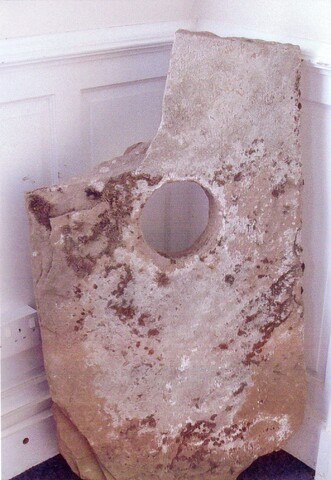
The other item of stone within the Church, which goes back to olden days, is the Bargain, or Betrothal, Stone, also referred to as the Priests’ Stone. I remember it firstly out of doors leaning in the corner by the porch but, more recently, it has been placed indoors against the wall by the door to the vestry. It is approximately 3ft 4in tall, oblong, with a fist sized hole about two-thirds up from the base, fortunately not damaged when a fair chunk was once broken off one corner of the stone slab. As with the font, it is seemingly not of a local natural material, but more like sandstone. One wonders if it had been carved specially for its purpose for Dalarossie, or brought from elsewhere. Maybe readers have seen similar stones in other places, and we could find out about their origins, also age. Meanwhile, whether bargaining stone or betrothal stone, it is a tantalizing glimpse of the past – picturing hands, gnarled with toil, clasped to agree a matter of the moment, or a happy young couple, hand fast in faith for their future together in the Strath.
Progressing from stone to wood, the box with the long handle, above the font, was reputedly the precursor of our velvet pouches for offerings. In days gone by, it is said, that the menfolk from the glens used to bring their dogs to the Kirk, none too peaceably, so perhaps the then Elders needed a receptacle less vulnerable for what they were about to receive! This is just my humorous thought – I’m sure there is a less ‘biting’ reason for having a wooden offertory container.
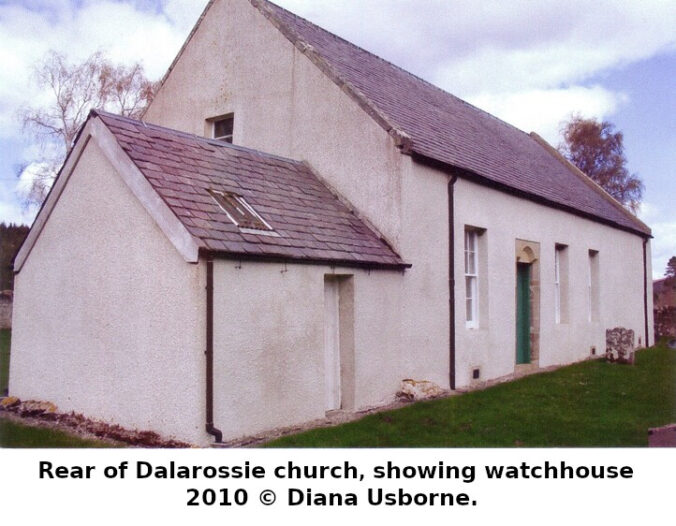
In previous centuries the horror of desecration of graves by the removal of fresh corpses, for medical research, became a custom (as by Burke and Hare) and the Church had ‘watch houses’ built within burial grounds so that relatives or parishioners could keep guard over the deceased for a certain length of time. The evil began in cities but disquiet obviously spread throughout parishes and a Watch House was built, paid for by local subscription, at Dalarossie, on the west gable end of the Church. It is a simple single storey stone structure, with a slate roof, which was restored by Inverness District Council, and has been more lately used for materials used by grave digging.
On either side of the offertory box hang two framed documents. These are copies of originals, unique and of importance to Dalarossie only. The two old documents had always been pinned to one wall of the Watch House but the Parish Registrar, Mr Murdo MacAskill, who also tended the Kirkyard, was concerned about the deteriorating state of the papers and gave them to me for safekeeping.
I too realized their importance and took them to the Archivist at Inverness Museum who kindly had each copied and framed for me to give to the Church, whilst keeping the originals, rather dog eared and water stained but safe from the elements.
These records are in two parts. The first is a list of all those who subscribed to the building of the Watch House, including Parishioners, “Strangers”, and those who sent a ‘partial contribution’, hopefully with a balance to follow. The list names approximately 100 souls in all, also place of residence, but the writing is difficult to decipher through old script and spelling, also staining. I could not be sure of a final figure donated, but the average given seems to range between 4/- to 1/- or 6d. The Minister gave 10/-, as did someone else, name unreadable.
The second frame, nearest the Church door, is known as ‘The Black List’. It is a telling account of “names referred to within the Parish who have declined to contribute.” There are seven of these, plus a further two “who promised but negated.” The first copy of the latter list is dated 26th June 1833, and it was recopied 28th March 1834, and signed Don’d McPherson. Was he Minister, or Treasurer/Clerk to the Congregation? I do not know whether the sum needed was realized before building began, or if Dalarossie Watch House was paid for as the monies came in.
There is a more substantial Watch House at Moy Church, built against the south wall of the graveyard, but I do not know if payment was combined within the Parish, or separately.
To end on a higher note. Once upon a time, the Minister at Dalarossie, in mid-Reading, was surprised to see many of the male members of the congregation quietly rise and leave the building, and return later, mission accomplished. I too had seen the herd of cattle that had found the gate unsecured, and they were cropping their way over hallowed turf, and floral tributes, and rubbing against memorials. All was sorted out and the congregation was able to hear the Word without further disruption.
Ann Glynne-Percy August 2001