Dalarossie – The Davidson connections with a remote Highland churchyard
It is ten years ago that I first ‘discovered’ Dalarossie, a remote church hidden away in the headwaters of the River Findhorn, in an area called Strathdearn. Like many visitors to the Highlands, I have driven the main A9 highway between Aviemore and Inverness, too often chasing the clock, rather than thinking about the history of the highland – hinterland either side of the road.
Ten years ago, I deliberately turned off the main road at the sign for Tomatin, not to visit the famous distillery but to head up the valley on single track road looking for a remote kirk marked on my Ordnance Survey map but without a name. I was in for a major surprise.
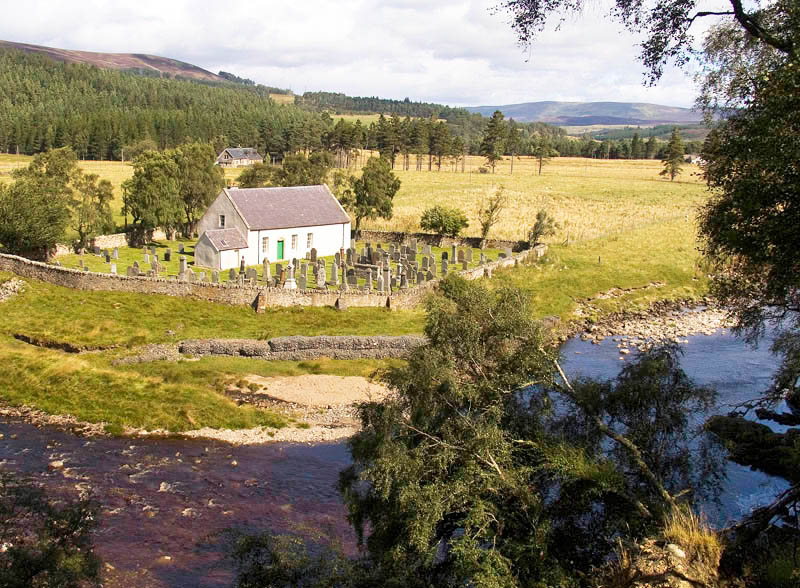
Dalarossie church is a small building located in a field on a bend in the River Findhorn. The field is gated. Sheep graze the field so look out for the usual hazards. Across the field, there is a further gate which is the entrance into the walled enclosure which makes up the churchyard. The current church dates from 1790, but this site is believed to be the site of an 8th century church dedicated to the Celtic saint, Fergus. Dalarossie parish was united with the adjoining parish of Moy sometime in the 17th century. The church is normally kept locked as is the church at Moy, so don’t expect to find it open except when there are periodic services or special open day events.
My surprise came in the churchyard where I found a significant cluster of Davidson gravestones, some of the inscriptions which I could read. Two years after my first visit, the Highland Family History Society [HFHS] published their detailed survey of the churchyard and I was able read their transcribed inscriptions in detail They found 217 memorial stones with dates ranging from 1751 to 2011; they listed 24 headstones with 42 Davidson names inscribed, with as many other inscribed names associated with the Davidsons such as spouses and other relations, and the names of their farms or crofts where the families lived. 13 of these headstones are arranged in 2 adjoining rows, an indication of their possible family links. The Davidson headstones are of different designs using a variety of stone; there was certainly no standard design being used by these families. At some stage in the past some of these stones have been set in concrete in an effort to stop them falling.
Prior to my visit, I had had no idea that I would find this extensive cluster of Davidson family history in such a remote location. What is even more surprising is the church at Moy within the same parish has only 5 Davidson headstones, with 9 named Davidsons; some of whom are linked in with the families documented at Dalarossie.
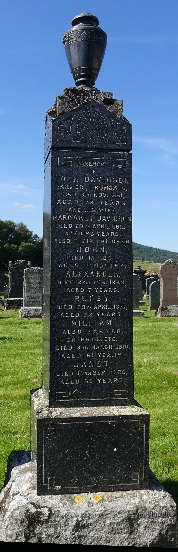
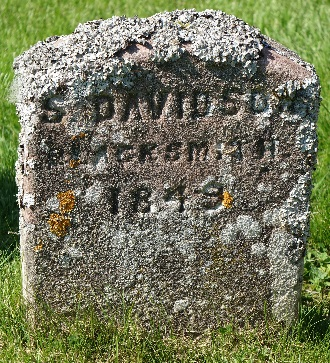
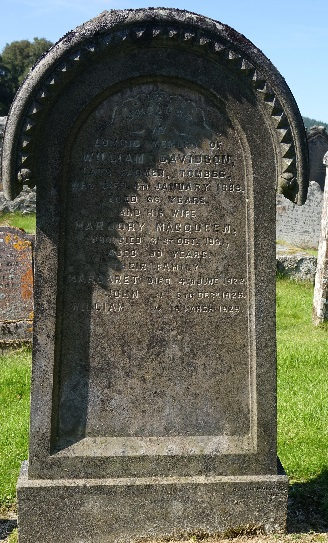
Three examples of the different designs of the Davidson gravestones found at Dalarossie
I have revisited this churchyard several times since 2009 in order to photograph the monumental inscriptions hoping to catch better light at each visit, sometimes I have been lucky. During the last 10 years I have gradually created an archive about all the Davidson names listed on these headstones and how many are related.
It has been possible to identify from the parish records at least 16 different Davidson families living in the Dalarossie & Moy parish at the end of 18th century. The Dalarossie gravestones and their inscriptions help to confirm this cluster of families. I suspect some of these families were related to each other but at the moment it is impossible to accurately determine such early family connections because of the lack of any formal records. The HFHS surveyors found no 18th century Davidson gravestones at Dalarossie. The earlier generations of these Davidson families possibly left no memorials, or any which previously existed, have not survived. The earliest date on any of the Dalarossie memorial stones is 1751 which is not old for an historic graveyard site such as Dalarossie. I suspect many earlier grave markers or memorials including possibly some Davidsons have been lost. At some point, there has been a ‘tidy up’ of this graveyard with many of the stones embedded in concrete. I wonder if some of the early Davidson memorials were lost at this point?
Another possibility is that the Davidson families only moved into the Dalarossie area in the 18th century, although I somehow doubt this. There is some oral evidence that at least one of these families has been in the area for several hundred years; see ref reference to John Davidson of Altnaslanach below
During my research, I have learnt much from others who have researched and written about this area long before I happened to find it. Dr Isabel Frances Grant [1887-1983], the founder of the Highland Folk Museum now located at Newtonmore, wrote about her many years exploring this area in her book ‘Along a Highland Road’ published in 1980.
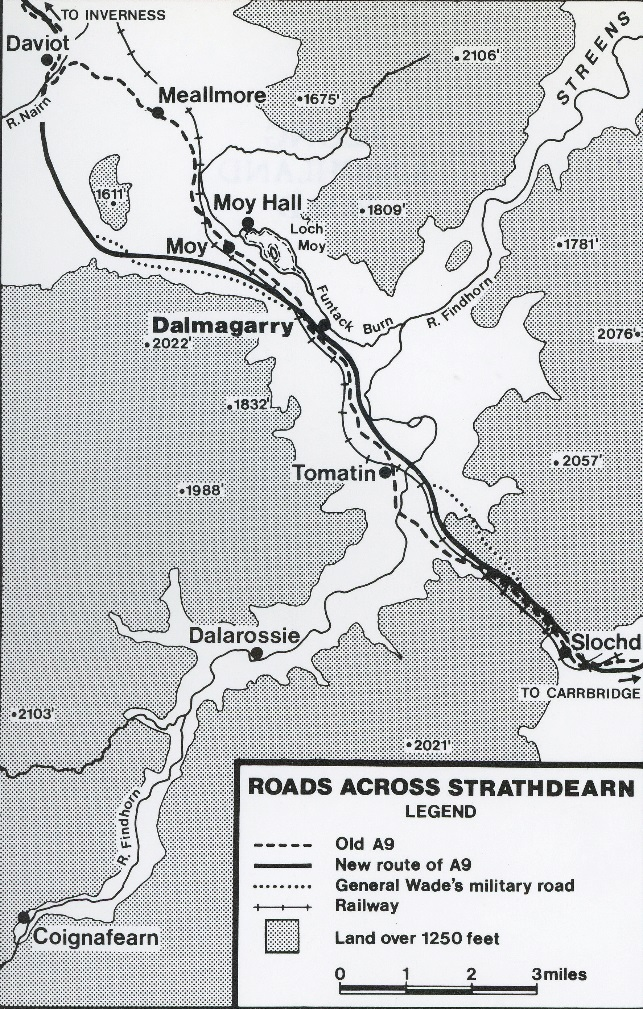
Map showing the location of Dalarossie
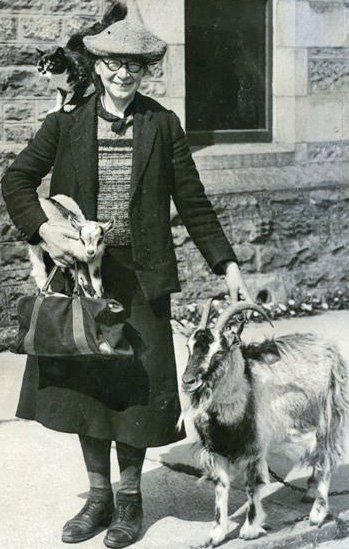
Dr Isabel Frances Grant
Isabel Grant makes special reference to “a man of great distinction Mr Davidson of Findhorn Bridge, whose people had been on Dunachton in my own forebears’ days there and come with them to Strathdearn”. I believe this is same man she lists as Duncan Davidson in her list of acknowledgements at the front of her book. It took me ages to work out who this Duncan Davidson was. He was in fact for many years the local registrar of births, marriage, and deaths for the Dalarossie registration district. No wonder he was so useful to Isabel Grant. He was still in office when he died in 1935 at the age of 70. His signature is just visible on the last death registration, prior to his own death; his handwriting was clearly beginning to fail. For years he would almost certainly known every family in the district. He would have been able to share extensive detail about the many different families including his own Davidson ancestors living in the area.
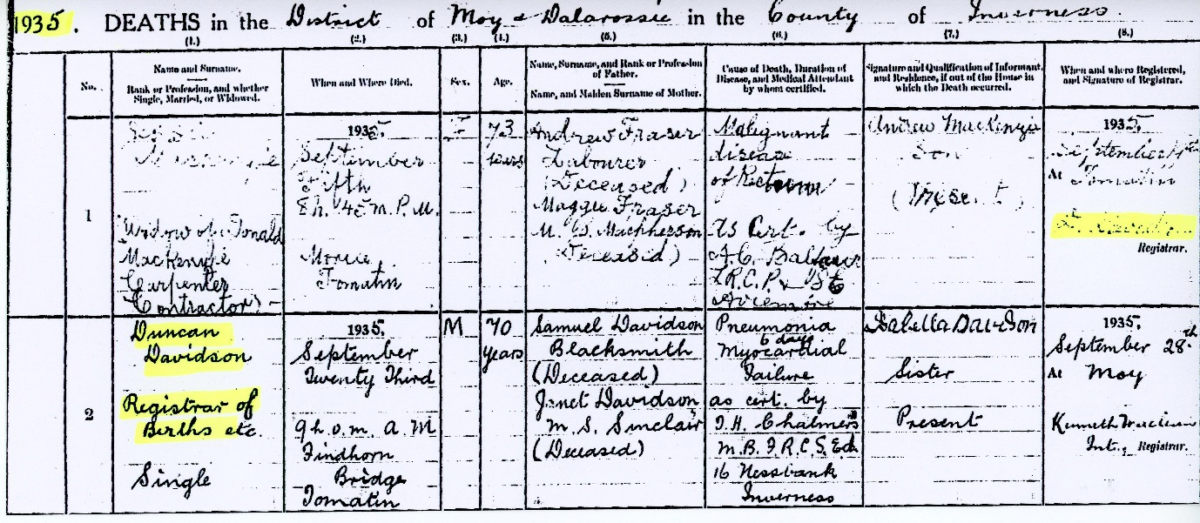
1935 Death Registration of Duncan Davidson of Findhorn Bridge, including his last registration where his handwriting was failing.
Duncan Davidson was buried in the family plot at Dalarossie with his parents and his brothers and sisters.
The paternal grandparents of this Duncan Davidson were both Davidsons, and so were his great grandparents; it is impossible to confirm if these couples were cousins because of the lack of surviving parish records. However, it does indicate the extent of different Davidson families being present in this area at the time. It is interesting to note that all the early generations researched so far were tenant farmers and crofters. However, the blacksmith occupation of Duncan Davidson’s father Samuel Davidson stands out.
The gravestones and the monumental inscriptions provide essential clues about these families which have helped to fill in the gaps in the early parish records. The ages of the deceased are nearly always listed included. This detail indicates their date of birth. It is noticeable how long lived many of the named Davidsons were. Life in the Findhorn valley may have been tough but many of the folk lived into their 80s and 90s. However, we should be careful about generalisations because we simply do not have comprehensive records. There may well have been unlisted children who died as infants for whom there are no records.
The names of the farms and crofts where these families lived is also stated so it has been possible to track the families by location. These farms include Corryborough, Dalnabeist, Tombeg, Blackhill, Drumbain, Achnagal, and Aultnaslanach. This last-named location is of particular interest. There is a report in the Journal of the Clan Chattan of a large international gathering being held at Moy on 4 August 1951 where some 1200 people attended. A presentation was made to Vice Admiral Mackintosh, then head of the Mackintosh family, by Mr John Davidson of Aultnaslanach, listed as the oldest tenant on the Mackintosh estate, whose ancestors had occupied the same farm for 400 years. I have not yet had the opportunity to research the Mackintosh estate papers to find any relevant documents. I would love to have met this John Davidson to have heard his oral history which might have confirmed the Davidson family presence in the area back to the 1500s, well before any other record currently available. Sadly, the Aultnaslanach farm building disappeared during major road works associated with the A9 highway in recent years and I have not yet found John Davidson’s direct descendants.
There are surviving records of 77 births or baptisms of named Davidsons in the pre-1855 parish records for the combined Dalarossie & Moy Parish. Sadly, there are no surviving marriage or burial records for this same period. Since the introduction of statutory registration of births, marriages, and deaths in 1855, there have been 11 Marriages, 77 births, and 53 deaths for named Davidsons registered in the Dalarossie and Moy registration district.
The statutory census records from 1841-1911 indicate how the number of named Davidsons has declined from 1861 onwards; the numbers are as follows:- 1841/35, 1851/45, 1861/50, 1871/45, 1881/37, 1891/31, 1901/29, 1911/23. To date we are not aware of any Davidson descendants still living in the Dalarossie and Moy registration district.
There is another source of early data. There are rare surviving census reports for 1821 and 1831 for Dalarossie and Moy. These hand-written reports list the different named crofts and farms with the names of persons resident including named Davidsons at these locations. It has been possible to connect some of these named Davidsons and listed locations with the later data but more research needs to be undertaken to understand these reports which are quite hard to read.
In 2017, The HFHS published a listing of the Moy Free Church baptisms between 1844 and 1854 researched by local historian Stuart Farrell. This is useful resource as Stuart lists all the details extracted from the notebooks of the original Free Church ministers including the names of the witnesses, which provide additional clues about the family connections.
Migration away from the land around Dalarossie in the 18th and 19th centuries has played an important part of the social history of the area. Dr Isabel Grant provides detail about changes in farming which have taken place in the area, causing the population to decline. She says it is impossible to tell how far the decrease was voluntary. Opportunities in North America, Australia, and New Zealand caused many to go. Army recruitment from the 1750s onwards was another cause. There were also planned emigration schemes. She reports of one [undated] example of large-scale clearing where the joint tenants of eleven holdings at Corryborough were evicted and apparently all went to America. In general, this area did not experience many of the problems associated with forced clearance of tenants.
By tracking the Davidson families, I can find plenty of examples where individuals or families moved away from the Dalarossie area into Inverness, or elsewhere in Scotland, or overseas from the 1850s onwards. There are probably more as I still have not been able to identify what happened to many of the Davidsons born in the Dalarossie area.
More recently it has been possible to link some of the descendants back to their Dalarossie roots.
Jennifer Highley from South Africa joined the Clan Davidson Association after making an enquiry about her great grandfather John Davidson [1834-1891]. He was born at Corryborough Croft but later left the land to become a successful and well documented wine merchant in Inverness. His family left a fine memorial in the Tomnahurich cemetery in Inverness. and the Inverness museum has an earthenware wine storage jar inscribed with his name and business.
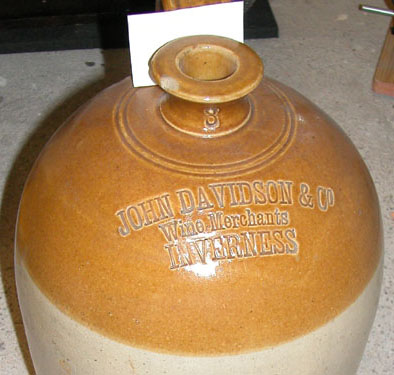
We have been able to identify his parents [John Davidson and Margaret Cattanach] and his grandparents [John Davidson and Margaret McGillivray] who are commemorated with separate gravestones at Dalarossie. As with most of the Davidson families connected with Dalarossie we can only track them back to mid-1700s from their ages at time of death stated on their gravestones.
Jennifer Higley’s paternal grandfather Douglas Davidson [1873-1932] arrived from Inverness in South Africa early in the 20th century, as a lawyer. Jennifer contributed a fascinating article about her grandfather and her ancestors in the 2014 edition of the The Pheon.
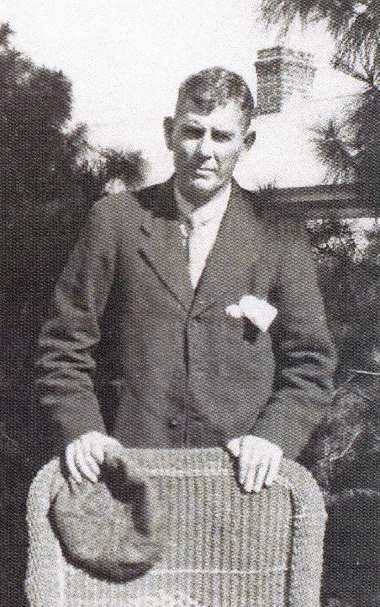
In recent years, postings on the internet have provided another source of useful links; https://patbrit.org.bil/supp/c0202.htm a website dedicated to recording the history of the British families in Southern Patagonia includes details of James McQueen Davidson born 1878 at Dalarossie. We can now track this James Davidson’s ancestors to one of the key Dalarossie families, his 1904 marriage to Lily Grant in Inverness, and subsequent emigration to Argentina. The data posted about his subsequent family in Argentina indicates that he raised a large family of 8 children who remained in Argentina and whose descendants are still living there…James and Lily died at Punta Arenas and are buried there.
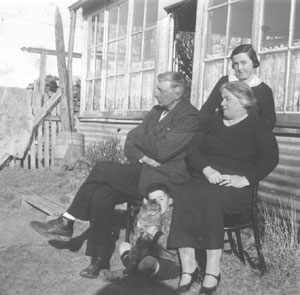
I am hoping this article may encourage others to explore Dalarossie and this very attractive part of the Central Highlands; just turn off the busy A9 highway and slow down and enjoy. If any readers with family connections to this area please get in touch. We still have much to learn.
Nick Hide
Clan Davidson Association