back to MISCELLANEOUS HISTORY index
[This article, written by Margaret MacKenzie, a freelance writer, was first published in the “Scots Magazine” in April 1948. Her niece, Mrs Anne-Mary Wharton of Beauly, has kindly given permission for it to be reprinted. We have appended another account of the Reverend James Leslie, taken from “Religion in the Highlands after 1688”. ]
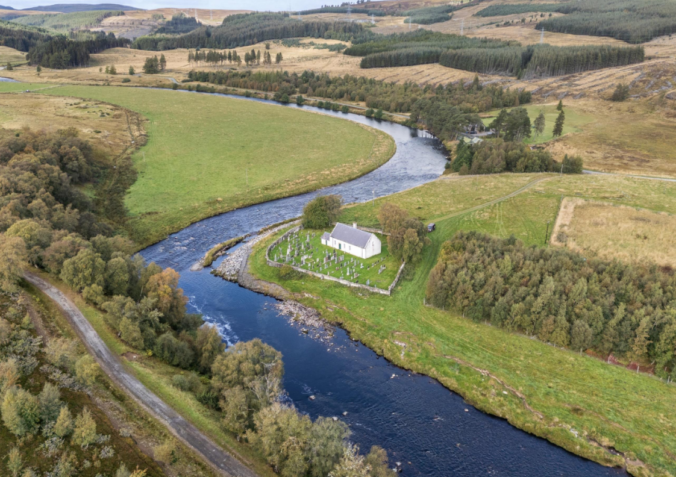
On the upper reaches of the Findhorn, that eighty-mile river which flows from the Monadhliath Mountains into the Moray Firth, lies Strathdearn. Upon a grassy bank above the water is a church of such simple and unpretentious architecture that a historian of the district designates it “one of the plainest of churches in Christendom”. This church, named Dalarossie, was built in 1790, and is the successor to a much older building which in earlier days has had no small share in shaping the lives and destinies of those who lived in these parts.
Gaelic-speaking people called the locality Dail Fhearghuis, the dale of Fergus, a missionary of the early Celtic Church. This Fergus lived in the eighth century. Coming from Ireland, he journeyed to the far north of Scotland, labouring in Caithness and along the eastern sea-board, until finally he settled in Angus. There his name is commemorated in the Well of St Fergus in Buchan, in the church of which his crozier is still preserved.
It is not certain why this first church on the upper Findhorn was dedicated to him. It is probable that in his wanderings he preached upon this spot, and henceforth caused it to be regarded as a place sanctified and apart, for all down the years the tradition persists that it was a sanctuary and refuge for the persecuted and distressed. Once inside its bounds, it was said, the fugitive was safe.
An old tale of the Strath tells of witches being chased by the Evil One. They knew, as they took flight, that their one hope lay in reaching Dalarossie Church, but at the very gates, Satan and his hounds laid hold of them. Not only is the site of the first wattled hut, or drystone building of St Fergus deemed sacred. The churchyard surrounding it was also regarded with special reverence, and they are counted as privileged who sleep their last sleep there.
Today it is recognised that the soil in this graveyard is of very special quality, scarcely one stone or pebble being encountered to a depth of seven or eight feet. Some tradition lovers go to Druidical days for an explanation, declaring that these priests sifted the soil. Others maintain that the followers of St Fergus are responsible, because of the care and diligence with which they tended the ground around their building. It may well be, however, that they, or their successors, built up the burial-place with silt from the river, flowing so near by.
In the north-west corner of the cemetery there still exists a curious structure made of turf – a semi-circle of seats with a platform arrangement in the centre. This had nothing to do with open air services, as one might reasonably conclude, but is a relic of the days when the old Highland custom of serving refreshment at funerals prevailed. Now, a birch seedling has taken root there, and is fast becoming a large and graceful tree. At one end of the church stood an old stone font, cut out of a large block of gneiss. After rain, quite a fair amount of water collected in the hollow, and it was quite a common occurrence for natives of the Strath to come here and wash their hands therein. They were those suffering from warts – and the infallible cure for such a complaint was to wash them in rain-water from a stone in a churchyard! There came a day, however, when, despite recent rain, there was no water in the font. A certain man who had an annoying habit of thrusting his stick into everything he was interested in, had poked it once too often into the stone hollow!
Inside the church an old hour-glass keeps the preacher up to time.
While in all Strathdearn the Church of Dalarossie was venerated, it was held in awe by the superstitious. They told of a skull which appeared and disappeared in strange fashion, and none of them would venture within a mile of the edifice on any Christmas night (old style) which happened to fall on a Sunday, else they might encounter a phantom team of shinty players, relentlessly finishing their game in the silent night. It is an old story, known to almost every boy who wields the caman. This game of shinty was played with vigour in Strathdearn in those days, usually on the glebe land adjoining the churchyard. Further up in the hills lived the families of Clan Aye, a sept now extinct. They instituted a Christmas match with a team drawn from further down the Strath. All went well, until one year, when Christmas Day fell on a Sunday. The Clan Aye on their arrival, found that the men of Strathdearn were not to play. Casting longing eyes on the good pitch, and not wishing to be done out of a game, Clan Aye picked sides from among themselves and played to the finish. When another Christmas came round not one of that shinty team was alive to tell the tale. One by one, so goes the story, they sickened and died, and their graves lie in the level stretch next to the river. Within another year, only two families of the name remained.
The River Findhorn was not always known as such. In former days it was spoken of as the Erne, or the Water of Erne – hence Strathdearn. The preface Fin, or Fionn, meaning white, was in all probability bestowed upon it by the Roman Catholic Church of Moray, in whose diocese it was, in order to distinguish it from other Ernes within the bounds, such as Auldearn. In old charters it is named “The Water of Erne”. In church records it is “The Findhorn” or “Fyndarne.”
The King’s Forest attached to the Royal castle at Inverness was in this upper strath of the river, and included the grassy bank where formerly it was believed St Fergus preached and where his followers built their first church.
At the time of the Reformation, one John Dow was appointed to minister to the wants of the people. In the year 1597, the Mackintosh Chief of Clan Chattan, whose territory it was, submitted to the General Assembly of the Church of Scotland a plan for placing schools and churches throughout his property, he himself to be responsible for the salary. Dalarossie and Moy, where the Mackintosh had his seat, were now united into one parish. At the Restoration of Charles II, the minister of the joint charge conformed to Episcopacy, but in 1709, a vacancy occurring through the death of a clergyman, the Mackintosh of that day applied for the settlement of a Presbyterian minister.
For a time all went well. The people were kindly disposed towards the probationers sent. Then shortly before the actual settlement, a wave of Jacobitism swept Strathdearn from end to end. The kindly feeling swung round to the other extreme. Candidates for the vacancy withdrew one by one, all except James Leslie from the parish of Ardclach on the Nairnshire banks of the Findhorn, and in the church at Moy, he was duly ordained. The proceedings passed off quietly, the close proximity to the proprietor’s house, and the assembly of Lairds and clergy, acting no doubt as a deterrent to any would-be disturbers of the peace.
But this effective bodyguard could not accompany the new minister on the Sunday following, when he set out on foot from his father’s home to take a service at Dalarossie. It was a walk of well over twenty miles, part of it through the grim pass of Pollochaig. Such a journey meant little to James Leslie. Did he not, as a student at Aberdeen University, walk from Ardclach to the Granite City?
On one occasion, when he had almost reached the town, he realised he had forgotten to bring with him a Latin book which had cost him seven and sixpence. Such a sum meant much in those days. Instantly he turned on his heel, retraced his steps, and, at his father’s farm, retrieved the volume. After a hasty meal he set off again for Aberdeen.
And so we find him, on this particular Sunday, walking with the long strides of the practised pedestrian, to take his service. On reaching a wood, he had his first brush with the enemy. Out from the trees came a crowd of women, their aprons filled with stones. They delivered their ultimatum – retrace his steps, or be stoned. James Leslie waited until the angry voices had quietened somewhat. Then he spoke. “Let the greatest witch among you throw the first stone,” said he. None wishing to avail herself of such notoriety, the women proceeded to discuss the next line of attack. In the confusion caused by the argument the parson slipped quietly away.
Arriving at the church, he found it empty, but on the glebe a crowd had gathered, watching certain local athletes “putting the stone”. These the clergyman approached, inviting them to finish the game and attend the service. His words fell upon deaf ears. The game went on. Then one of the crowd challenged the minister to join in the sport. He accepted, upon the condition that if he threw the stone further than any of them they would come into the service.
Leslie stood over six feet in height, and was powerfully built. His one throw went considerably further than that of any of his opponents. Instantly the new minister rose in their estimation. They kept their word, and followed him into the church.
But opposition was to last for many a day. It was even said that on another Sunday a ferocious bull was let loose upon him while he was making for the church. As the animal lowered his head for the toss, Leslie had the presence of mind, and the strength, to strike the animal right between the horns with his strong walking boots, and so laid him low.
For fifty years he laboured in Strathdearn, slowly but surely winning over the people, and so transforming their way of living, that when his charge was handed over to a successor, twenty-three elders were ordained in one day in the Church of Dalarossie.
The last glimpse which local history gives us of James Leslie, now an old man, is in the role of protector to a lady in distress. The Battle of Culloden had been fought and lost. In the Mackintosh castle at Moy, the Jacobite wife of the Chief, the Lady Ann, who had rallied eight hundred men to the Cause, heard the dire tidings, coupled with the news that the Clan regiment had suffered disastrously, only three of its officers surviving. James Leslie also heard the news of the battle. Politically his sympathies were no doubt Hanoverian, but the Chief’s wife was in danger, and that was sufficient reason for him to hasten to Moy Hall.
On the morning following the battle, two detachments of Cumberland’s men arrived to remove all available cattle and household goods, and to take prisoner the Lady Ann. Leslie was standing by her side when they entered the room. Vainly he argued with them. They were heady with victory, and in no mood to listen to an old parson’s pleading. Money they must have, and the Lady Ann as their prisoner. Some indeed were in the act of laying hands upon her, when one of their own officers came on the scene. Instantly he recognised in the lady a former friend. The romanticists maintain he was once in love with her. There was no further threatening or violence, but Sir Everard Faulkner, lover or not, had to do his duty. Lady Ann, after bidding farewell to James Leslie, was escorted in quite a peaceable manner to Inverness, where for six weeks she was detained as a prisoner of war.
Far up in Strathdearn, at an altitude of twelve hundred feet, are patches of grassy moorland. Here in former days the inhabitants of the Strath repaired with their cattle for the summer sheiling. It was a happy time, with work and song, and good company, and some called the district Fairy- land; others the Abode of Peace. On a summer’s evening, in the silence of those hills, one feels either name is appropriate.
[This account of the Reverend James Leslie is taken from “Religion in the Highlands after 1688” which was published in “The Original Secession Magazine” in 1890 as one of a series by “a Highland Minister” (the author’s name is not given in the original publication)].
At Moy, 12 miles south of Inverness, Alexander Cumming, the presentee of Bishop Falconer and a bigoted Jacobite, continued in full possession of the charge until his death in 1709. A long vacancy of seven years followed. Efforts were made to obtain the faithful services of Daniel Bethune, but they were unsuccessful. In 1716 worthy James Leslie, a licentiate of the Presbytery of Elgin, was called by the Presbytery, and inducted on August 23.
The following Sabbath Mr Leslie walked up along the banks of the Findhorn to preach at Dalarossie, the other church of a united parish, in the face of strong opposition. Within two miles of this place of worship, at a wood overhanging the river, he encountered a crowd of women with aprons well filled with stones. Blocking up the narrow way, they bade him return and excitedly assured him that if he proceeded further they would certainly stone him. Mr Leslie, nothing daunted, replied to the angry clamour: “Let the greatest witch among you throw the first stone!” No one among them cared for so unhappy a pre-eminence and, in the confusion that ensued, the valorous minister was allowed to proceed.
Arriving at the church, he found it empty. There was a multitude in the graveyard engaged in “putting the stone” – the husbands, brothers and sons of those women from whose hands the preacher had so happily escaped on the way. Leslie urged the athletes to leave their sport and attend his service, but they emphatically refused and in return urged him to take part in the game. Thereupon he offered to throw the stone (the test of physical strength) once, on condition that if he surpassed them they would adjourn to the church. Being a very powerful man, his one throw far exceeded the mark reached by the foremost of the company. The new parson at once rose in their estimation, and they readily acknowledged his superiority and followed him into the church. The “strength-stone” lay for many long years untouched on the spot on which it had fallen from Mr Leslie’s hands; and the sermon preached on that bright autumn Sabbath of 1716 was the beginning of a great moral revolution and blessed revival in that beautiful strath.
Nearer Inverness, in the parish of Daviot, the erratic curate, Michael Fraser, succeeded the worthy Alexander Fraser, who had been deposed for non-conformity in 1672. The outed minister survived the Revolution, but not being comprehended in the Act of Parliament of 1690 restoring the survivors of the persecution, he remained at Abbotshall. Michael seems never to have shown any concern for the spiritual interests of his parishioners. As early as 1675 he was enjoined by the Synod that in time coming “he abstain from all limning and painting which hitherto has diverted him from his ministerial employments”. He continued in Daviot till his death in 1726.