INDEX of Ann Glynne-Percy Essays
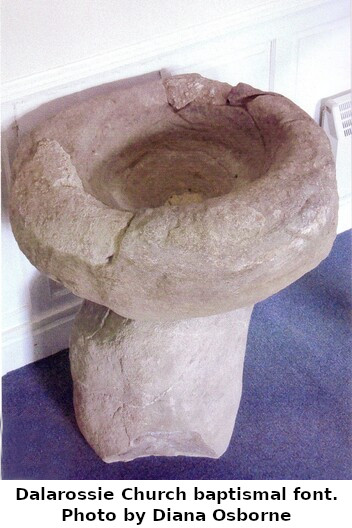
If only the amazing ancient bowl-shaped stone could tell us of its beginnings – how long ago it was formed, whether by nature or by human hands – and what purpose or ceremony the dwellers of Dail Fergus used it for in olden times. Sacred or pagan?
It was supposedly found in the ground when the glebe land was being ploughed, but I have been unable to discover when, or by whom, but they must have recognized it as of possibly religious significance, and it was placed within the Kirkyard, leaning against the wall near the gate, and I first remember seeing it there.
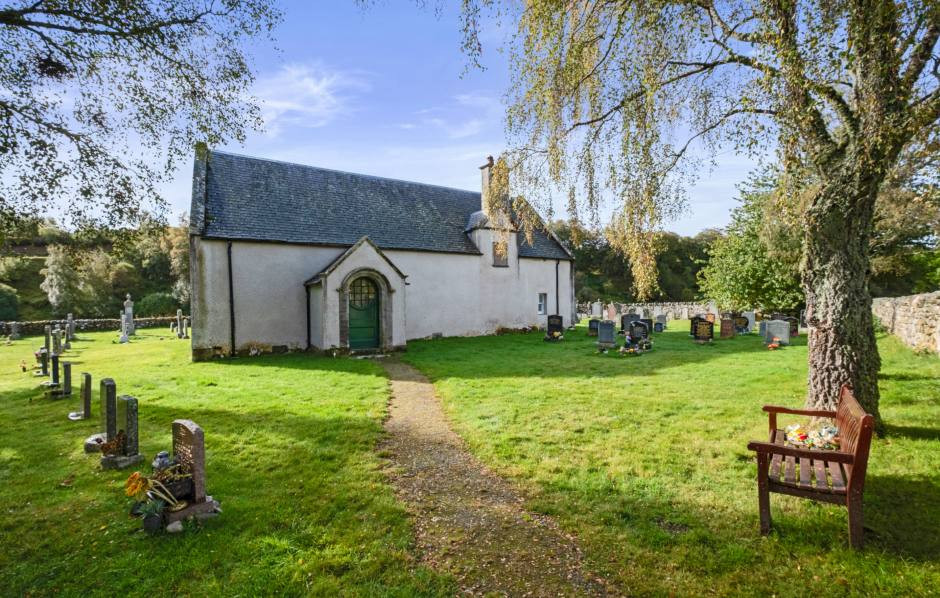
During the incumbency of Mr Cameron, who was Minister from 1932 – 1940, a visiting Anglican Bishop saw the stone bowl and expressed concern that it was outside, and maybe at risk from being ‘appropriated’ for display elsewhere, and he advised that it was taken into the Church for safekeeping. This was duly done.
I cannot recall exactly when it was created into a font, in 1940s, but Miss Kathleen Mackenzie of Glenkyllachy and my mother Mrs Douglas Bulloch, were responsible for the transformation, obviously with the Church powers-that-be and the congregation of the Parish of Moy and Dalarossie. A suitable support for the bowl was a problem as, contrary to some belief, one had not been found originally in the glebe ground.
I remember very clearly going with my mother to the nearby ruins of Harriet’s Croft, not far from the Old Dalarossie Schoolhouse, where we searched for a stone in keeping in appearance – upright, and already worked so as not to look unhewn, and also the correct height. It was a summer’s day, with the sun warm on our backs, swallows overhead and the sound of curlew and pewits calling, anxious about their chicks, and wheatears bobbing as we moved about among the footings of the old walls. We found what we were looking for at one corner and, in the course of time, it was deemed appropriate for its new purpose and Murdo MacAskill skillfully crafted the unique font we know today. It was no easy task, as the bowl was heavy and uneven in shape, with no especially ‘good’ side and even some broken bits on the rim, probably from the ploughshare that unearthed it.
There has been much speculation as to how it became rounded inside. There is a reference to it as ‘the monk’s grinding stone’ – did that mean as a large mortar, as in pestle and mortar, for pulverizing grain, or herbs for medicinal purposes? Another theory is that it was formed by water current, maybe with a rounded stone to ‘birl’ about inside, as it is of a softer rock than the native granite.
I had hoped to find out when the font was first consecrated, and the name of the first infant to be baptized; he or she would be a pensioner now but it would be fascinating if they or their family could fill in this piece of the story for us. Mr MacCuish was probably Minister at the time, up until 1946, then Mr Angus MacDonald became incumbent in 1947.
When petrol was scarce, my mother and I bicycled to Church and we always put on extra pedal power as we passed Corrievorrie because Allan Tulloch had a large black bull in the field nearest to the road, and we were not too sure of him!
Dalarossie has a timeless serenity about it, whether with all the pews filled or literally when two or three are gathered together, as I remembered in winter in wartime when the service was held in the vestry with the fire on in the grate.
This little history of the font is written after queries to local friends and to the best of my own recollections, but pieces of information are missing and if anyone could fill them, their knowledge would be very welcome. I know there are statistics in Church records outwith the Parish, but there has not been time to delve as far as Edinburgh before the Newsletter is printed.
Ann Glynne-Percy
April 2001