INDEX of Ann Glynne-Percy Essays
In 1743 one ferocious wolf was still at large on the eastern part of Moy estate, where it terrorised the inhabitants. Its final act of atrocity was to attack a mother and two children on their way across the hills, and to devour the little ones. In great distress the poor woman made her way to Moy Hall to tell the Mackintosh what had happened. He immediately summoned his clansmen and vassals to assemble the following day, at noon, to hunt down and kill the evil beast.
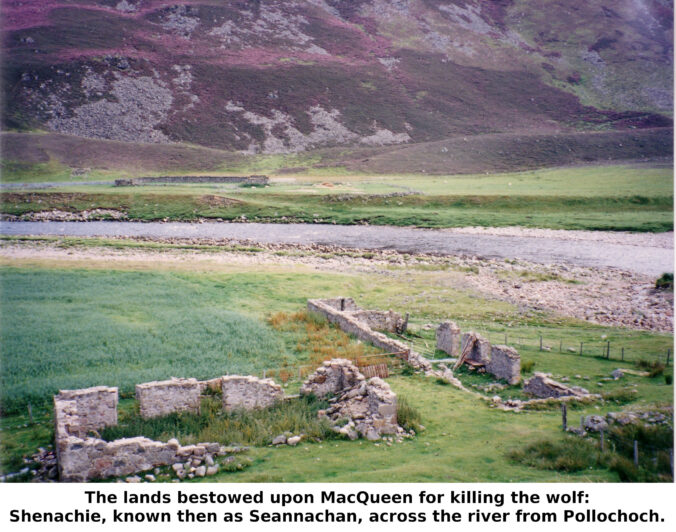
On the south bank of the Findhorn, at the Streens, was a little mansion house and farm, Pollochoch (meaning the pool of the little black one) and the laird, MacQueen, was a tall, strong and courageous man. He was expected to lead in the hunt, and the Mackintosh became vexed and then angry when the appointed time came and then went, as he was accustomed to wait for no man, least of all for an hour.
Finally MacQueen arrived, to be coldly greeted by his Chief demanding what had kept him when there was quarry to be despatched. Is this what you’d be after?Pollochoch replied, and withdrew from beneath the folds of his plaid the dripping, gory head of the wolf, to the amazement of all present.
He told then how he had overcome the creature singlehanded: As I came by the east of the ravine, there I foregathered wi the beast. My long dog turned him. I buckled wi him and dirkit him, and syne whuttled his craig and brought awa his countenance, for fear he might come alive again, for they are very precarious creatures. My noble Pollochoch͟ cried the Chief in ecstasy, the deed was worthy of thee. In memorial of thy hardihood I here bestow upon thee Seannachan, to yield meal for thy good grey hound in all time coming. This land, meaning ͚ the old field͛ of ten acres, was across the river from Pollochoch’ s home.
The quotations are from the book “The Moray Floods” by Dick Lauder. The spellings of place names change over the centuries, but the ruins of Pollochaig can be seen, downstream of the box bridge , or pully-hauly as we always knew it. The site was occupied at the time of the 1821 census, but not thereafter. The Shenachie land inheritance of the brave grey hound was inundated by the great spate of 1829, but its need of meal was way past by then.
Further downstream, the Findhorn turns righthanded, with a long dark pool and a precarious track above it, known as “the coffin path”. During his 50 years of ministry in the Parish of Moy and Dalarossie, from 1716, the renowned Rev James Leslie had to negotiate it, possibly on a parochial visit to Daless, or Quilichan beyond. His garron lost its footing and fell down towards the depths, and it is said that the minister had the strength to pull his frightened steed back up to firm ground and safety. I’m glad he did not have to buckle wi the last wolf as well!
Ann Glynne Percy 2003