INDEX of Ann Glynne-Percy Essays
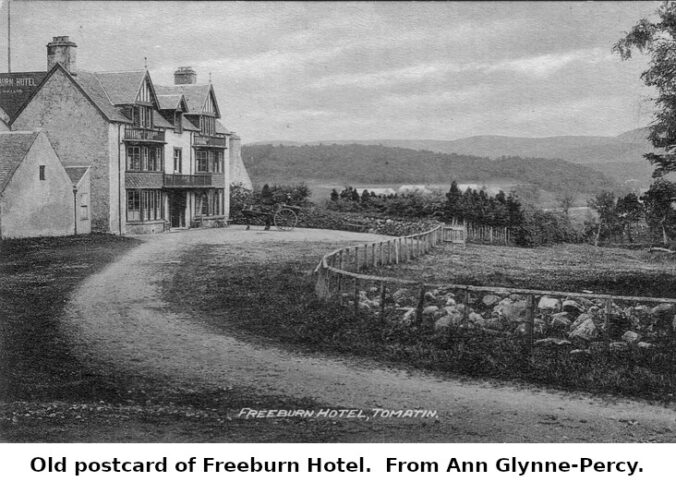
The Hotel, or Inn as it would have been known in those days, was built in 1745 and was a King’s House on the highway to Inverness, as was Dalmagarry. Prince Charles Edward Stuart stopped there on his way to the ill-fated battle of Culloden the following year.
Freeburn was also a trysting place for drovers and their cattle to pause and rest on the long way to the market at Falkirk, and ultimately, Smithfield. It must have been a lively scene, the men glad of refreshment and to exchange news of their journeying, dogs scrapping and beasts milling about in the surrounding parks.
I do not know the name of the landlord in 1829 but in August that year there was the devastating Moray Flood and he gave a very vivid account of how it affected the hotel: “On Monday 3rd at about 8am the water fell from the heavens more tremendously than he had ever seen it fall in his life before, accompanied by a violent NE wind, and it continued thus until about 4 o’clock on Tuesday evening August 4th. The Findhorn and its tributaries were all up by noon the first day but the flood did not reach its height until early Tuesday. So tremendous was the rain it penetrated every door, window and chimney in the house and even through places where no crevice was suspected. The floors of the lower rooms were actually covered with 3 inches of water from the rain alone and the servants were employed during the greater part of Mon. and Tues. carrying it out in tubs and buckets.”
There were farm buildings adjacent to the hotel and “the cattle in their stalls were standing knee deep in water pouring on them through the roofs. The poor animals were nearly starved, for the people who were sent out to cut a few bundles of green corn for them were actually unable to remain out under the fearful torrent that fell from the sky. Many acres of grazing land were lost to the Free burn, also some arable, and two fine bridges near the Inn were carried away by the tributary streams.” (probably the Alt no Frithe and the Alt Dhubhag).
The above account of the deluge came from the book “The Moray Floods” by Dick Lauder.
The buildings themselves were structurally undamaged, it seems, and would have remained much the same for the next 60 years or so, until the coming of the railway in the 1890’s. Suitable accommodation was then required for the senior staff and overseers of the engineering work, which cut through Mr MacBean’s Tomatin estate. As owner of the Inn he was asked if something could be done to improve the quality of the place and make it fit for the new clientele. Descriptions of it were far from flattering, including verminous and damp bedding ‘injurious to one’s health’, poor food and lack of servants or any comforts.
Anyway, matters took a welcome turn for the better as the Freeburn was rebuilt and refurnished in 1895 and the proprietor, Mr A Robertson, took great pride in his establishment “which has the honour of being patronised by Royalty, the Nobility and the Aristocracy”! He produced a marvellously flamboyant brochure including advertising provision of a ‘fine stud of carriage and saddle horses’ and all manner of wheeled transport for hire — even sleighs.
The hotel was also apparently the headquarters in the district of the CTC [Cyclists Touring Club] and every inducement was offered to cyclists to put up there for the night — “having an easy run thence to the capital of the Highlands”. I thought it was fascinating turn of the wheel of progress, as it were, with the modern day trans-Europe cycle way passing along the same route as 1890’s.
In 1904 a Mr F Macleod was proprietor of the Freeburn and was a member of the newly formed Tomatin Golf Club committee; he seemed to be very willing to help whenever needed.
I first remember the hotel in the 1930’s when the Miss Gunn sisters were in charge and kept a very high standard in all respects. Many of the guests were regular visitors who came in the sporting season and to fish the Findhorn.
The public bar was in an annexe built to one side of the main building, with a separate entrance — definitely only menfolk there in those days — and there was a hatch through into the main lounge for serving drinks to residents. The dining room was on the first floor, with a hoist to bring food up from the kitchen.
The water supply came from a spring, near the warehouses now, and on the upper storey the cold tap ran very slowly. As a child, staying at the hotel, I remember waiting for ages in the chilly bathroom for the hot water already in the bath to be reduced to a bearable temperature.
The last landlords of the Freeburn known to our family were John and Rose Curtis, who had been butler and cook to my grandparents, Colonel and Mrs Bulloch. The daughter, Iris Curtis, married Bobby Thain whose parents lived at the Distillery and he manned the petrol pumps and helped generally. The Curtis’s decided to retire and move south in the latter 1950’s and the Freeburn was sold and no longer part of Tomatin Estate.
The adjoining farm belonged to the Distillery but was gradually taken out of use. It was of traditional design, buildings round a square, with an interesting winnowing floor on the northern side. There was a Garvie threshing mill still in situ and it was given to the Highland Folk Museum at Kingussie as a working machine for demonstrations.
Many years have passed, proprietors came and went, ending with the old buildings no longer in use except as a store beside the addition that was the Little Chef restaurant, and now the shutters have literally gone up. The petrol pumps too now have gone and we still miss Jean there, who worked so hard to try and keep things going for the sake of the community and always had a friendly word for everyone.
However, rumour has it that the Freeburn has a new owner and it would be wonderful to see it restored to its historic place as a hostelry in the Strath once more.
Ann Glynne-Percy, August 2006
I can hardly believe that it is almost ten years since I wrote the article about the Hotel. Having ended on a hopeful note, it is very sad to make known that our revered building is no more — just a heap of rubble. It was not the elements or a dramatic fire that brought about its end, just someone’s decision to make use of demolition machinery with devastating effect. Plans are afoot to alter the Tomatin junction to the A9, with the dual carriageway continuing to Moy, which may involve the Freeburn site but the hopes of the community would be a for a Phoenix arising, as it were, that would take away the ruins of what had been the heart of Strathdearn for hospitality and enjoyment for more than 250 years, and a ceasing replacement be built.
Ann Glynne-Percy , updated in 2015
