INDEX of Ann Glynne-Percy Essays
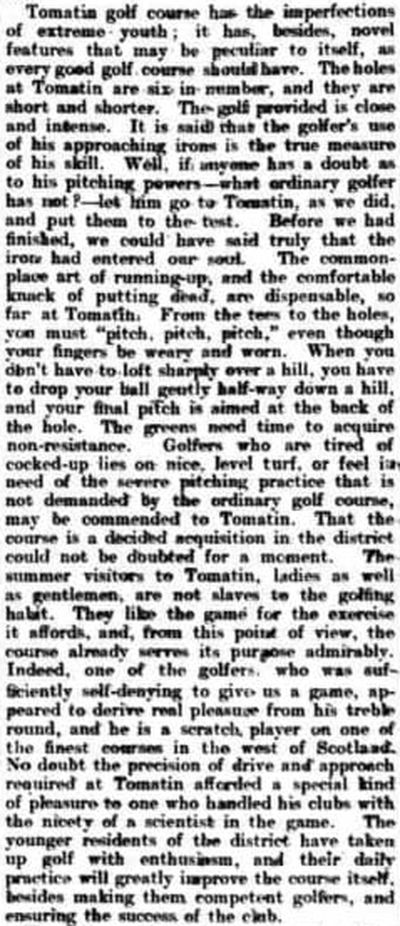
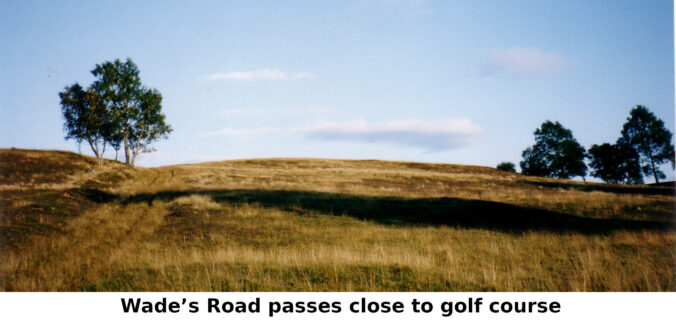
This ambitious venture began as six greens, situated on either side of General Wade’s road between Smithfield, Mo Dhachaidh and the old A9, with the first green and clubhouse nearest to the layby and approach road to what was Fred Kelly’s lorry park. There is a venerable larch tree nearby, which could have many a tale to tell of close fought competitions and much enjoyment for many years, as well as voluntary labour on a challenging site.
A public meeting chaired by Mr Junor, the Station Master, was held on 23rd September 1904 in the village hall (then tucked in on railway property between Bail an Duin and the stone viaduct) to discuss the question of a golf course “for the place.” A letter was read from Mr Macbean of Tomatin, granting the use of Tomatin Aird during his lifetime for the purpose in view. Mr MacGregor, tenant, who was present, expressed his approval of the project and stated that he would have no objection as long as his lease lasted. The thanks of the meeting were conveyed to Messrs Macbean and MacGregor, and it was agreed that a general meeting be held at an early date to elect officers and a committee.
Thus the germ of an idea for a golf course at Tomatin took root, and there swiftly followed several meetings, held in the waiting room at the station – much more cosy than the words suggest, with a fine coal fire in the grate. Mr Ludovic Macbean Esq, Tomatin, and E Cox Esq, Balnespick, were elected Hon. Presidents; J Macdougall Esq, Tomatin, President; the Rev A J Morrison, Manse of Moy and John Mackintosh Esq, Ard Kyllachy, Vice Presidents. The Secretary to be A J Macdougall, Tomatin; Treasurer, Mr A Noble, Woodville. The Committee: Mr J B Leonard, Convenor, Midvie; Mr J W MacGregor, Heights; Mr J Junor, Station House and Mr F Macleod, the Hotel.
Two names are a puzzle to me, ‘Ard Kyllachy,’ and ‘Migvie’ – no ‘Dal’ as now. The Macdougalls lived in a fine house at Hazelbank, burnt down latterly. ‘Woodville’ was later ‘Strathview,’ then Cottage of Free; and in the latter decades of the last century the Heights was renamed Smithfield before reverting back to its original name – although in his great enthusiasm for the enterprise, Mr MacGregor at one stage named it ‘Golf View!’ He agreed to accept a rent of £2 for the course and made a present of that due for the first year as a donation to the club.
Fund raising went on apace, and a Mrs Sefton arranged concerts. All members paid an annual subscription of 5/-, with an entrance fee of 2/6d. Ladies 1/-, visitors or non-members 6d a day or 1/- per week.
The successful tender for the golf course work was from Mr S Macdonald, at £14. Turf was offered by Miss Shaw, Miss Ross, Mr Macbean and Mr Noble, Free. The conveying of it to the greens was given to Mr Sharp, carter.
After many discussions and several readjustments to the course, it was finally declared ready for play on 13th July 1905, and at the opening ceremony Mrs Macbean of Tomatin drove off from the first tee with a specially donated silver mounted club, suitably engraved. Play followed by foursomes – “the sporting nature of the ground affords scope for a great variety of play, and being situated about 1100 ft above sea level, is probably the highest golf ground in Scotland to date.” Lady members of the Club provided tea afterwards. (How I wish there had been a photograph to record the occasion).
By 1908 it was suggested that three further greens be added, and the need for a shelter or Clubhouse emphasised. There were by then 34 Club members on the roll. A special meeting of the Club was held in February 1910 to decide about the Clubhouse – hitherto there had been insufficient funds for a building. The Hon. President, Mr Macbean of Tomatin, came forward to offer a free site, as well as £5 towards the erection of the Clubhouse. He was heartedly thanked for his generosity, as well as his kindly attitude towards the Club since its commencement. It was agreed that “the Clubhouse is to be built on the small knoll to the North, not far from the first green, constructed of wood, 14’ long, 9’ wide and 7 and a half feet high with a corrugated iron roof to jut out horizontally on one side to form an overhead projection 3’ broad, supported by four wooden pillars. It would have 3 windows, 16 lockers, and be lined and varnished within and painted without. The work all to be done by Mr William Dunbar, carpenter, Dalnahoin, Corrybrough, Tomatin.” There were accounts for various fittings indoors and out – including one from Messrs Howdens & Co for 18 rhododendrons @ 9/-. plus 1/- for carriage!
Mention is made of Mrs Campbell, ‘Sawmill Cottage,’ who was appointed caretaker at a salary of 10/- per annum, for which she offered to open and shut the building during the golfing season and keep same thoroughly clean. (I am not sure where her cottage was – there was a sawmill near where Fred Kelly’s lorry park used to be, but Mo Dhachaidh was a ruin, known as ‘the burnt house,’ as far back as I can recall, 1930s. I well remember ‘Hercher’s’ Funfair that came to the site each summer – great fun).
Subscriptions raised locally amounted to £32.19/- and previous expenditure was £29.9.8d, so the Clubhouse was not only free of debt but a surplus of 7/9d was handed to the Treasurer! Members could now enjoy a copy of the Daily Graphic at a half-penny to peruse in the Clubhouse during the season, and a mower was purchased in 1912. There were 40 members on the roll in 1910.
I will not weary readers with details of minutes of meetings, changes of membership and expenditure – mostly maintenance of the greens and keeping rushes and heather at bay, not to mention rabbit and cattle incursions, also Mr MacGregor said that players looking for lost balls were damaging his crops!
Many more lady members joined the Club and in 1915 it was noted that “competitions were greatly enlivened and the comfort of members kindly considered by the Matrons who provided an excellent tea on each occasion.” There were numerous generous prizes donated, with several impressive-sounding cups, including the Noble/Macpherson Ladies Challenge one and the Callingham Cup – Mr Callingham was one of the Tomatin Distillery directors. From 1916 it was decided not to compete for cups as, owing to the War, there were fewer players taking part – these recommenced in 1919.
In 1920-21 there was an exchange of letters between John Macdonald, timber merchants of the Sawmill, and the Golf Club members over damage to the course by their carts, but there seemed to be no satisfactory result from their requests for recompense, lasting several months.
By 1922 competitions were being held with neighbouring clubs including Carrbridge and Rothiemurchus, and players were transported by ‘motor,’ hired by Mr Farquhar – Distillery Manager and a staunch supporter. Mr Mann took over the Heights in 1923, following the sadly regretted death of Mr MacGregor, who had been held in high regard and had done so much for the Golf Club ever since its inception in 1904.
I do not know when the final games were played, probably up until after World War II, with a dwindling number of players, but the Golf Course had given great enjoyment and competition for seniors and juniors alike, and a sincere debt was due to those who helped voluntarily to maintain it, despite Nature’s efforts otherwise.
One visiting sportsman in 1923, Sir Perry Robinson, commented that he had played in various parts of the world, including Trinidad, the Canaries and China, but the Tomatin Course had “features of its own.” He and his wife had come to play with 10 balls – had lost 127, but still possessed 8!
The clubhouse went into dignified retirement as a henhouse – the lockers providing ideal nest boxes!
Ann Glynne-Percy
(Written in 2002 and revised in 2017)
2017 Postscript:
The Golf Course area is of ancient historical interest because on the upper level there was once a settlement in the Bronze Age. There is not much to see, just the low profile of three hut circles, or round houses as they are now known as, and one of them was partly overrun by General Wade’s Road. It is fascinating to think of a small Pictish community living there; tending their animals, hunting, and growing basic crops all those hundreds of years ago. On the site, between the buildings and the A9, there are a number of small mounds of stones, which were clearance heaps to make more ground for cultivation. When I found the first one I thought it might be a burial mound, but there are too many. Also, the deceased were interred in stone box-like cists, a crouched burial which would probably leave no remains owing to the type of soil there; maybe offerings of basic pottery or a rudimentary tool, not weapons. There were similar families of people living in Strathdearn during the same era, all almost within sight of each other in similar hut houses, at about 1,000 feet above sea level, above the nearby river flood plain and with easy sight of approaching strangers, although it seems to have been a mainly peaceful area then.
The inhabitants would have been pagan, worshipping sacred groves or springs, and I wonder if the unique Invereen carved standing stone was in place for special ceremonies or great gatherings as at an Equinox, overseen by the spiritual shamens or Druids.
How I wish an archaeological investigation would be undertaken on our Golf Course remains so that we could maybe see any artefacts buried there; shards of pottery, early types of tools, even charcoal, to bring the Long Ago to life for us.