INDEX of Ann Glynne-Percy Essays
The first Post Office was at Baile an Doune, where Mrs Betty Watson lives now, and then it was moved to the shop – MacDougal’s Stores; the unusual corner window dates from 1862. I do not know when it was moved again, but the Post Office I remember was the house now known as “The Old Post Office”, where Miss Annie Ross was Postmistress in the 1930’s and 40’s. She was a very keen golfer and a leading light among the lady players at Tomatin’s own golf course, opened in 1905, between Mo Dachaidh and Smithfield (once known as Golf View as the tenant, Mrs Macgregor, was one-time President of the Golf Club).
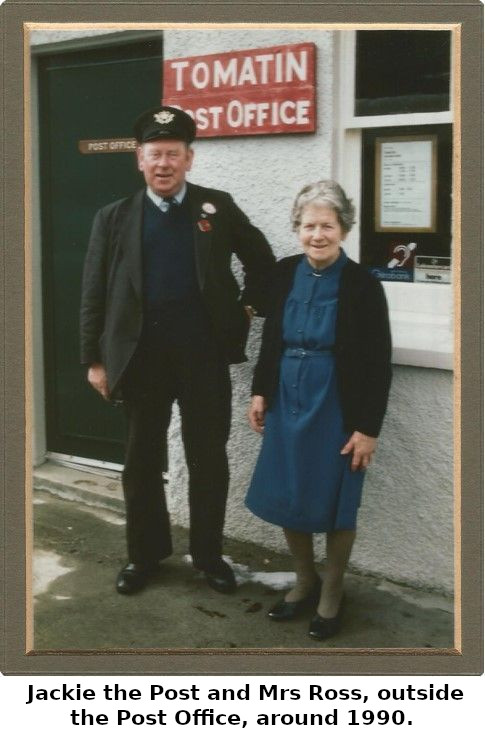
Miss Ross was succeeded by Mrs Ross, who was Strathdearn’s diligent and respected Postmistress for many years until her retirement in 1985. She had been awarded the British Empire Medal, a well-deserved tribute to her long service to the community. She must have seen many changes in postal business during her tenure, with ever-increasing paperwork and form filling – a few of which have gone by the wayside. I recall having to buy a wireless licence; and a dog licence at 7s 6, obligatory for any dog over 6 months but I think Guide Dogs and working collies were exempt. Telegrams were part of communication, especially when not every household had a phone – ‘flimsys’ as a rule in a yellow envelope but there were fancy flowery ones for special occasions.
At Christmas and New Year time, parcels were too numerous to find shelter within the Post Office, and the old village hall beneath the stone viaduct was used to store them before delivery. After that hall was taken down, in the early 1960’s, the packages lay on the Post Office forecourt under tarpaulins.
As well as being responsible for the mail, Mrs Ross had the telephone exchange to manipulate. This seemed to consist of a large ‘peg board’ on one wall, with leads to be plugged in to connect subscribers. I remember with embarrassment the problems my small son Richard caused one summer when we were staying with my mother, Mrs Bulloch, at Cottage of Free. He discovered that if he lifted the receiver a kindly voice would say “Number please” and that was an invitation for a long and chatty interlude for the toddler with Mrs Ross, who was in despair as with the line in use she could connect no other callers. A tactful request later came to grannie to please keep the youngster away from the phone. I’m sure many emergency calls were dealt with, but one affected our family directly when my grandfather had to ask Mrs Ross to call the fire brigade when his home, Tomatin House, was ablaze one summer evening in June 1955.
During the war and after, we were on a party telephone line and had to count the number of rings to know when to answer: 1 was for the Distillery, 2 Balnespick, 3 ourselves and 4 Mrs Hoare, the Gleann (now Glenan). It could be tricky if you wanted to phone out, as you had to check that the line was free or otherwise, and not be thought listening in to someone else.
Mrs Ross’s son, Mr MacKay, was a “saw doctor” in Inverness and everyone who needed a sharpening job done used to take their saw to the Post Office to be collected for attention. Whatever would passers-by on the old A9 think nowadays if they saw a person enter the premises with a sack-covered bundle, or even an undisguised blade – reach for the mobile and dial 999!
Mrs Ross made delicious marmalade and sometimes one would open the door and be greeted by a mouthwatering warm orange smell – and she might scurry off in the middle of a postal transaction to check if things were beginning to gell.
Opposite the Post Office was the District Nurse’s house, now Craiglea, and she used to leave a slate at the door to let one know where she could be found if needed. I remember her having to bicycle everywhere, in all weathers, and home confinements were the norm which might mean pedalling up the Glen at night. I don’t know who was the first nurse to have a car, but even then it was garaged at Old Mill Road, where Meg’s garden is now, so the poor soul might be soaked walking there before even driving to her ‘case’.
Next door to the Post Office, alongside Station Road and facing the stone viaduct was Tomatin’s well-remembered butcher’s shop belonging to Maggie and Mary Mackenzie, described in any earlier article about vanishing buildings.
I have a difficulty, as the postmen were an essential part of community life ….. but I am not sure of names, or when the round ceased to be by horse-drawn vehicle and became motorised. Sandy the Post is the only one from days gone by I hear mention of – do our Senior Citizens remember him?
The first record of a GPO delivery service I have is from 1868 when on receipt of a petition to the Postmaster he agreed to have a “post runner” to go once a week from Tomatin to Daltomich, up the Glen, at the expense of the Post Office. The people of the district then paid for the service twice a week, and such was the benefit they wished to have the runner three times a week, also to be paid for by themselves.
Was Daltomich chosen because it was an Inn or rest house on the drove road from further north to Strathdearn, and thence over the hill to Speyside and the south? The weary runner would have been made welcome and had a chance to pause and refresh himself there – also correspondence may have been sent onwards in the pouches of drovers themselves, but this latter is just my own speculation.
The first ‘Postlady’ was Mrs Mowat, who lived with her sister Miss Phimister at the Old (Carding) Mill, and cycled the district during and after the war. She did go up the Glen, but not every day. Even so, it must have required great spirit and fitness to cover such a large area, on a bike without all the gears and refinements of today, not to mention the dim lamp to comply with wartime blackout regulations.
Seventy years of remembering the post office here seems surprisingly vivid yet, and we are fortunate to still have one in 2006, back in its previous situation at the Stores and now presided over by Mrs Evelyn Nixon, skilled at managing state of the art gadgets. I wonder how Mrs Ross would have coped with a computer and printouts … with fortitude, I’m sure. There was also a sub Post Office at Moy, with Mrs MacDonald in charge – it was in a front room of the Old Manse but closed when Mrs MacDonald retired.
I have not been able to give names to all our posties over past years, eah valued for making sure the Mail got through whatever the conditions were, but I cannot close without mentioning just one – “Jackie the Post”, well remembered as a local character all his days.
Ann Glynne-Percy February 2006.