INDEX of Ann Glynne-Percy Essays
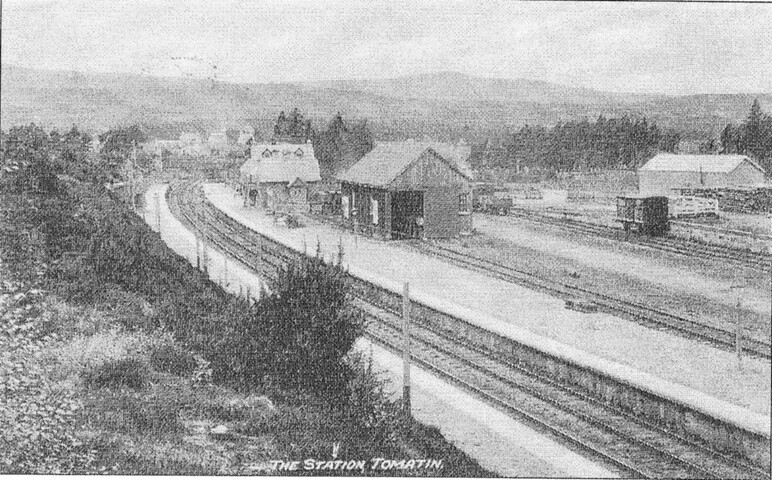
The Highland Railway came through Strathdearn after the completion of the building of the viaduct in 1898, The directors needed a name for the local station so they asked Mr Maclean of Tomatin if they could use the name of his property as so much of the line came through it. It must have been a great upheaval for everyone involved, including the erection of the ‘stone’ viaduct as well, but a leap into the modern age when there was a regular train service up and running between Inverness and Perth and the south, with our own regular stop.
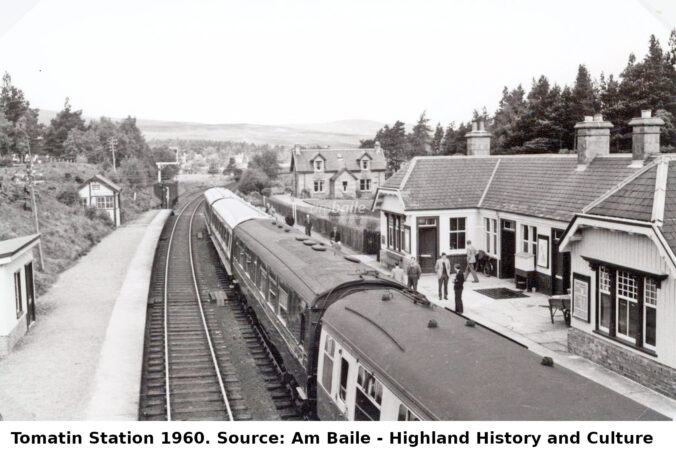
The station buildings were built of wood, quite plain as different from Moy which was of stone with architectural features as befitted a place where Royalty and persons of importance would alight, as guests of the Mackintosh of Mackintosh in the shooting season. Tomatin, however, had great character of its own, and was a hub of much coming and going, both for rail passengers and goods.
I am not sure if Mr Junor was the first station master but he certainly made the golf club members welcome to use the waiting room for the AGM in 1905, and he was president of the curling club, whose rink was not far away, beyond the yard. I remember Mr Smith best, 1940’s and 50’s — my elder sons when small knew him as “Mr Miff” and had to be discouraged from swinging on the great gleaming handles in the office, for working the points.
That place was a haven of warmth, always a roaring coal fire in the grate, paraffin lamps glowing after dark, and the sound of to bells heralding an approaching train, or its departure. The station master had a huge wooden desk in the middle of the room with timetables and paperwork, and there was also a ticket machine with some ready printed, others blank for the names of far flung destinations.
Was it Mr Smith who was an accomplished barber? I remember my grandfather going off to the station with his towel and comb, to join other menfolk having a quick trim between trains!
There was a safety procedure by which ‘the tablet’ was passed to each engine driver – it was of metal, in a leather pouch, on a rigid loop held out by a member of staff waiting on the platform, and the driver leant from his cab to catch it. Engines then were ‘open plan’, hot if you were facing the furnace, but probably very cold with your back to the tender of coal, especially- in a blizzard. When winter set in, snowploughs were attached to the front of each engine, and they could batter their way through most drifts. There was one ‘ultimate weapon’ I remember, a monster of a machine with a plough encasing its whole front, for serious clearing of the track. Slochd was bad for filling in, and trains did get marooned there.
Apart from the station master’s office there was a waiting room and a hallway for luggage and parcels. There was also an open area, like a verandah, where you could stand and wait and watch all that was going on, or buy from the slot machines – the cigarette ones were for Players (or was it Woodbines?), and a Frys chocolate bar one. I remember after the war began and sweets were rationed, hopeful souls used to rattle at the dispenser in the off chance that some goodies still lurked within.
There was a large two-wheeled handcart for mailbags and I can still see in my mind’s eye the crates with dead rabbits, held on a bar by their crossed hind legs, on their way to market. There were so many at some times of the year it was said the sale of them paid the keepers’ wages. A happier sight was the hampers of pigeons, cooing as they waited to be released, then circle around before speeding of to their home lofts.
During the shooting season it was exciting seeing the sleeper train draw in, and parties descend with all that was needed for a stay at each of the lodges, staff included. Dogs travelled with the luggage in the guards van at the rear of the train.
I still remember the excitement of my first journey south by sleeper, with my mother, before the war and then years later, when I was at college. The third class compartments had four bunks, each supplied with a pillow and blanket, and I recall the train thundering through the dark with the names of stations being called out when we passed, also the clank of milk churns at some, and always the sound of the anonymous railwayman whose job it was to walk the length of the train and tap the wheels of carriages with a metal hammer, to be sure they rang sound.
Tomatin Station had a goods yard and sidings. I remember all the coal and anthracite for Tommy Fraser, Ard, who was the merchant keeping supplies going in the war, though most households would have eked out their ration with peats cut themselves, as we did, or firewood. There was a sawmill along the Station Road to process all the local timber felled for the war effort, and we used to get ‘backs’, they were nice and easy to split.
One of my greatest treats was to have a ride on the distillery ‘puggie’. This was a real Thomas the Tank style engine, pulling a wagon which took the casks to and fro between the warehouses and a siding at the station. but I can’t remember who the kindly engine driver was.
There was a footbridge above the main rails and to stand on it as an engine passed below was fun though smuts were a hazard.
Apart from the larger platform at the station there was another on the other side of the tracks, where the signal box was/is, and I can still hear in memory the clunk as the arm fell, and looking towards the viaduct you could see the train snaking towards you, shuddering to a halt and steam rising from pipes underneath. Thinking of coming to a halt, sometimes northbound trains couldn’t pull up in time and overran the station and, after dark, we saw the metal of the wheels glowing red hot from heavy braking, opposite home, Cottage of Free.
During the war many vital supplies made their way north by rail, including to Invergordon and maybe even Scapa Flow, and one could only guess at what they were, everything being hush hush, and the Home Guard making sure all was secure on the Tomatin part of the line, especially with the viaduct possibly being vulnerable. Once I remember being with friends while a freight train was halted and, being very daring. one of the Hoare boys lifted the comer of a tarpaulin to see what the funny round shapes beneath were – and saw mines!
Once war was over it was so good to see lights from the passing carriages again, reflected against the snow in winter. Trains had seemed almost ghostly going by all in darkness.
After Dr Beeching’s axe in 1960’s, how one missed the station. It had been at the heart of things for so many of us – great welcomes and regretful departures over the years – and a debt of gratitude is owed to all those men of Tomatin who kept the lines safe (and points defrosted). Their dedication is part of our past now.
Ann Glynne-Percy November 2005