By John Ferguson (Pedlar)
Index — Chapters: 1 — 2 — 3 — 4 — 5
Chapter 3 – The Glen
- Bridgend to Clune
- Knockando, Strathnoons and Dalmigavie
- Coignafearn
- Coignascallan, Daltomach, and Glenmazaran
- Garbole, GlenKyllachy and Dalarossie
- Auchintoul, Kyllachy and Woodend
Bridgend to Clune
Turning left up the Drumbain brae which is a steep climb up from Bridgend where there is a large concrete constructed bridge which was built in 1926 spanning the Findhorn River. Gwen Grant was telling me that her father worked on the construction of the bridge when the distillery was closed during the recession years. This bridge replaced the iron one that Thomas Telford built in 1833 and which was no longer fit to carry the heavier loads that were carried along the A9 by motor transport.
The brae was part of the old A9 and went all the way to the Slochd summit and south. Half way up the length of the brae you can turn right on to the Clune road and the first place you come to on the left is Drumbain Farm. This is where Lal Macdonald and his wife Lexie moved to after he sold his house ‘MoDhachaidh’ to his father to finance the takeover of the farm. This was my half-way stop when I fished the burn as a child and this was about a mile from the bridge-end, there was always a welcome with tea and home baking and if it was lunch time there would also be a plate of soup or a share of whatever they were having. Margaret and Mary were the daughters of Lal and Lexie and if the fishing was not good Margaret, Mary and I would go and hunt rabbits out at the back of the farm on the hill between the farm and the Slochd. There were a lot of junipers growing on the hill and they had two dogs that were very good at catching them, one would flush them out while the other would catch them when they ran out.
After Drumbain was Balnagornach where I remember two children called Jean and Nan Kennedy. If I’m right I think Jean was a tall girl who wore glasses and pigtails and was dubbed Keyhole Kate after a girl in the Dandy comic, such was the cruelty of children.
About four or five hundred yards further along there was a derelict house called Press and then on to Clune Lodge which was about another half mile further on. The shooting tenant was a Captain Reid Walker and he was a bad tempered old sod. When I did the Sunday paper round and had to meet him at Bridgend he would be in a hellish rage if I was five or ten minutes late. He seemed to forget that I had to deliver to all the houses around Tomatin before I got to the bridge and most of the time I had to walk the round. I can’t remember if he owned the estate or just rented it. The lodge was up a brae on the left among a clump of trees.
Carry straight on for two or three hundred yards and here was where the Head Keeper stayed as well as Clune Farm which was rented by a family called the MacPhersons. There were two boys John and Billy. John joined the police and was very tall while Billy took on the workings of the family farm and was a very hard working farmer and reclaimed a lot of land. He then went to farm near Nairn where he became one of the country’s top breeders of Simmental cattle taking numerous prizes all over the country. The Gamekeepers were Duncan Don and his son Alex. Duncan also had two daughters, Jean and Betty. Alex and Betty still live in the village.
As a child I went to the grouse beating at Clune walking there and back as well as walking the hills all day. It was at Clune that I first saw a peregrine falcon kill a grouse that was flushed by the beaters but because of the line of beaters it did not pick the bird up and when we reached the grouse its head had been knocked clean off. Another thing that made going to Clune beating profitable was that just before Christmas old Duncan Don would come round all the houses of the ones that helped him out at the beating with a haunch or fore shoulder of venison as a way of saying thank-you which was most acceptable and greatly appreciated. There was one year when we all put our money together from the beating and Alistair, Mother and I bought a dry battery wireless set which was a great advance on the old wet set.
Knockando, Strathnoons and Dalmigavie
The next set of buildings along the road was Knockando Farm which was also worked by a MacPherson. I think that his name was John and he was a uncle of Billy from Clune there was one son John, and two daughters Barbara and Jean I do not know where the girls went but John went on to run the farm with his main interest being breeding Black Face sheep. At one time the Tomatin sheepdog trials were held on the hill above Knockando and a very good hill trial it was with a double lift which attracted a big field of handlers.
As you walked on the next place was the ‘Strathnoons’. There were two Strathnoons, Easter first then Wester. I don’t remember if anyone lived there as they were both derelict at the time. Further on there was a fork in the road. To the right was the bridge that crossed the Findhorn and to carry straight on brought you to Dalmigavie Lodge and the Keepers Cottage. The keeper was Willy Hendry and his wife Lilly with their two sons, John (or Jock) and Billy. I spoke of Billy earlier as it was he that married my foster sister Kathleen and I shall talk about Jock later.
The Laird of Dalmigavie was a Christy Miller. A mile or so up the river was Dalmigavie Farm where the McCabe family lived. I don’t know if he farmed it as an independant farmer or for the Estate. Their daughter Cathie was one of three children trapped in the Freeburn Hotel in 1955 by a snow storm that lasted for three days. A further mile or so up river took you to the bridge above Coignascallan. Crossing it would take you on to the tarred road on the other side of the River Findhorn, on the right bank as you travel up the river. So far we have been going up the left bank along a dirt track road which started at Dalmigavie and where, at the last part, there is no road at all. The tarred road stops at the old Coignafearn Lodge which was a ruin that had sheep pens round it. When I was there it could have held 2000 sheep. The hill was let for grazing to many of the farmers around about the area, even as far as Dulnain Bridge.
Coignafearn
Donny and Sid Ross would walk over from Kingussie gathering the sheep on their way over. They would then stay the night for the sheep shearing the next day down at the old lodge where there would be twenty or thirty clippers with hand shears. Old Jimmy Geddes would go out and shoot two stags which Auntie Jean would make into a stew in a big cauldron to feed all the men. There were also plenty of drams and screw tops of beer, home baking and always the kettle filled with tea – sorry I forgot to say that Auntie Jean was old Jimmy’s wife. Jimmy had a tragic end when, coming home from Tomatin one night, he took a heart attack and went into the river between Daltoach and Coignascallan. When I think back poor old Jimmy was destined to die by water, for in 1957 when he and Auntie Jean were on their way home, the bridge at Glenmazeran was washed away. Fortunately that time he had the Land-Rover and they were able to get out.
From the old lodge up there was what was known as the straight mile from the lodge to the Calder burn. There wasn’t a twist in the road for a mile. Another mile and a half on brings you to the New Lodge of Coignafearn which they say is thirteen and three quarter miles from the Telford bridge. Although this was the end of the road we could carry on up the riverside track to Dalbeg which, in 1957, was just a bothy with a small paddock that was fenced off to hold the ponies that did the hill work. They could be left there if we were late off the hill and went back to the Lodge by Land Rover. From there, about another half mile further on, are two burns that meet where the Findhorn starts. The Abhain Cro Clach (Cro) and the Eskin burns are the names of them. The Cro to the left and the Eskin to the right.
When I worked for a season there in 1957 the shooting tenants were a party that were referred to as the Barclay party although the estate was owned by the Whitbread family. The Barclay’s shot the grouse and they also shot one day of the season at the head of the Cro for ptarmigan, shooting on average forty or fifty brace. We, the keepers and ghillies, had to lead the ponies carrying the guests up to the top then back down this time carrying the birds in a game bag on our backs. As you walk up the Cro, about half way up there are the graves and the story goes that some cattle raiders from Lochaber came to Strathdearn and raided the cattle there. The Strathdearn men caught up with them on their slow return journey with the cattle and put them to the sword, they were buried where they fell. The high top, if my memory serves me right, was a boulder and a rock covered plateau with little vegetation between there and Kingussie making it the most direct route to Lochaber and the south.
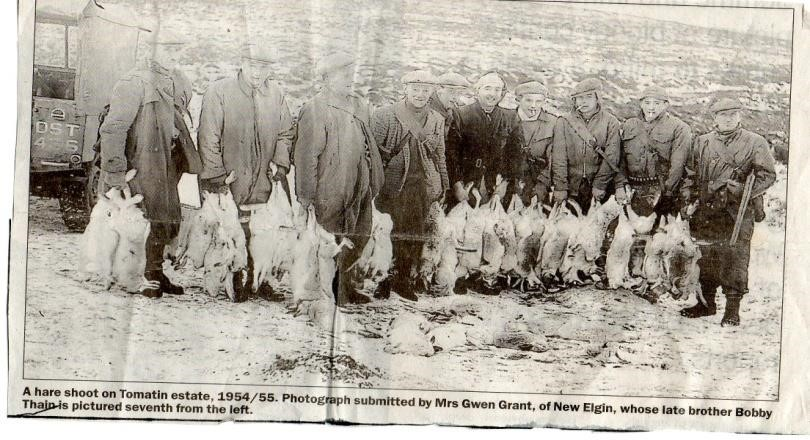
Old Barclay had no consideration for his staff and there was one day we were walking up grouse shooting when Barclay asked Geddes if they could shoot hares to which Jimmy said ‘only on the way home’ as he was not having the boys carrying hares all day. So on the way back they shoot seven or eight hares and on getting back to the lodge Old Barclay asked for the hares to be hung in the larder and he would get cook to make jugged hare. Two weeks later Jimmy asked Barclay what he was doing with the hares as there were maggots falling of them. His reply was “Oh dam, I forgot to tell cook and I do like jugged hare. I suppose you will have to give them to the dogs” to which Jimmy replied “I am sorry sir but they are too far gone to give to the dogs, I would not like to make them ill in the middle of the season” to which Barclay said “Well just give them to the boys in the bothy, it is a shame to waste them”. We were considered lower than the dogs and that was how the working class was sometimes treated. Unknown to him the boys in the bothy lived well out of the larder with plenty of fresh grouse and venison.
The Head Keeper’s house was up above the Lodge and to the right were the dog kennels and larder. Down below on the other side of the road beside the river was the bothy which was built of corrugated iron with tongue and grooved wooden panels inside with a big open fire. The other person that shared the bothy with me was Jock Hendry from Dalmigavie. Jock was in the T.A. with me and the Under Keeper was Finlay McGillivray who was also in the T.A. Finlay lodged with Auntie Jean and Jimmy as he lived there all the year round.
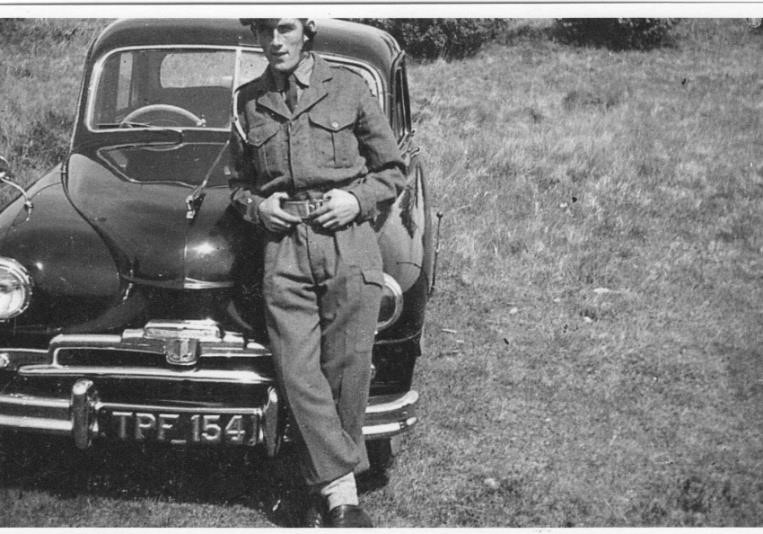
At Jimmy Geddes’ funeral the coffin was walked out past the lodge gates and the carrying of the coffin was organized by (Sergeant) George MacLeod with the Tomatin troop acting as pall bearers. This was done with military precision and the change over of pall bearers was done without stopping and it was something I was proud to be part of.
Another thing that happened when I worked at Coignafearn was one time when Finlay and I took a retired Colonel out stalking. He had just the one day and had never stalked a stag before that day. The beasts were very spooky and kept moving on. Finally about half past five they got into the beasts and the Colonel shot two. I was pony man and had the best hill pony that one could wish to go to the hill with. When I went up to the beasts it was decided that we would take the heads off the two beasts and load them both on to the one saddle. The colonel said that he would carry his own rifle. Finlay would carry the trophy heads and I would lead the pony. Everything went well until we got to the ‘Coire Challic’, there the track left the burn to go up over a rock face. By this time darkness had started to come down and the only way out was up over the top of a big rock face by a single goat track.
Finlay started to strike matches to look for the track but could not find it so I threw the reins over the saddle to join in the hunt. With that ‘Charlie the pony’ started to sniff the ground and took off up the rock face. I just let him lead us out and we followed in single file over the top knowing that one wrong step and it was a shear drop to the bottom which we could not see because it was so dark. When we got to the Findhorn it meant a long walk up the left bank through soft ground to the bridge then back down to the Lodge. Charlie knew this so he just walked into the river and out the other side and as I was pony man I had to follow. The Colonel said that he would not let his men go where he would not go himself, so with the rifle above his head and water up to his chest he crossed the river with us. On reaching the Lodge he told us to go home and change then join him at the lodge for dinner. At dinner that night he said that it may have been his first stalk but he would never have a more memorable one.
There are many more stories to tell of my time at Coignafearn and I have maybe dwelled too long on my journey but before I go I should like to leave you with this wee poem that I wrote when I was there …….
From Coignafearn the Findhorn comes
Joining up with many burns
The Cro, the Eskin, the Elrick, are some
That help this river on its speedy run.

Down over rocks and hills it runs,
Picking up the smaller burns,
Past Glenmazeran on to Garbole,
Past the churchyard on it gurgles

On through hills and dells it flows,
Faster now with melting snows,
Taking with it what it can,
Nothing safe no beast no man

On and on past the school,
On and on to the Colonel’s pool,
Past the Freeburn on the brae,
There’s where many a fisherman stay.

Through the hills on to Cawdor,
Rushing, rushing, no time to ponder
Why the salmon goes up-stream,
To spawn and die where it’s just been

On and on past Forres it goes,
On and on to the sea it flows,
For this river has no place to stay,
Until it gets to Findhorn Bay.
At the end of the season of 1957 my time at Coignafearn had come to an end and it was time to head back home to ponder over my future. I arrived back at the house about lunch time and when Alistair came home for his lunch and said that John MacDonald (‘Young Shorty’) who was now the manager at the Distillery, wanted to see me. I went over that afternoon and he offered me a job in the malt barns which I accepted and within the year I got the job of Head Maltman when Jock Kiel left and until they got another married Head Maltman. This job in the distillery entitled me to the ‘end of the season’ bonus which was about £150 and as result I was able to buy my first car which was a 1938 Wolseley and was an ex London police car which I often wish that I had the insight to have kept it. It was a big square black box with huge chrome lights. The shine that the body work took on was magnificent but then again the thickness of the paint was thicker than the metal on a modern day car. Another feature of the car was that should the car need to be jacked up a wooden panel was lifted in the foot well of the front passenger seat where the mechanism for a hydraulic jack which could be set to lift whichever wheel was needing attention or pairs of wheels or all four wheels at one time. The upholstery was of thick brown leather and always had that rich smell of leather which was warm in the winter and cool in the summer. It was the first car that anyone had seen with a reversing light.
The rear number plate was in a glass box and when the car was put in reverse gear, a bright light came on. Once when coming home from Inverness up the Drumossie brae the car started to make a banging noise but I still managed to drive it home. After getting home I was told that the ‘big end’ had gone and I asked around to find out how this could be fixed. Once I knew I set about to remove the piston and the crank shaft. Then I took it to Billy Paterson who had a friend that worked in the Rose Street Iron Works in Inverness who would make the bearing for it. When I got the crank with the new bearing home, I worked until two o’clock in the morning to fix it and when it came to putting the piston back in I came up against the problem of how to depress the rings and hold them in while I pushed the piston down. This was achieved by cutting the bottom out of a bean tin which held the rings in place until I was able to push the piston home and from there the rest was straight forward. The car went well for a year or so after that until the tyre law came into being. By this time the tyres were down to the canvas with the leather gaiters to stop the inner tube from coming out through the tyre – already showing. The tyres were a strange size and would have cost too much to replace and it seemed cheaper to get another car so the Wolseley was sadly dumped.
Coignascallan, Daltomach, and Glenmazaran
On with my journey down the glen and back down the road on past the old Lodge and past the bridge that we crossed before starting the journey to Coingnafearn, the first place we come to is Coignascalan. This was where George MacLeod lived when he first returned home from the war before moving to Garbole to work for the forestry until he became the Keeper at Tomatin House Estate. This was also where Donny Geddes, a nephew of old Jimmy Geddes, stayed. Donny was Under Keeper of the Estate and he married one of the Nicholson daughters from the Station road – I think that she was called Helen.
Next on the right was Daltomach which was part of the Glenmazeran Estate, owned by Lord Elphinstone. It was here that the McGillivray family moved to when they left the sawmill at Tomatin. Before the family moved to Tomatin, they originally stayed across the bridge from Coignascallan around Coignashie. I remember Mrs McGillivray telling my wife June that when her last son George was born she felt the pains come on while she was milking the cow and as she was all alone with her nearest neighbour being a mile away on either side of her there was nothing for it but to have the baby on her own. She went into the house and gave birth and had the baby washed and fed it before going back out to finish milking the cow. She was a tough old nut and as George was her twelfth child, perhaps it was nothing new to her in those times. The MacGillivray children were Chrissie who married a chap called Watt. She had identical twins and the only way that she could tell them apart was to look at the back of their ears as one of them had a small mole behind one ear. Annie married George Cameron and Molly married Willie Munro and their son became one of the top rally driver in Scotland. Sheila married ‘Lewie’ Fraser and then there was Rachael who was married to Callum Grant who worked at Dalwhinnie Distillery. Gladys married Sandy Mackay after about a twenty year engagement and last in the girls was Barbara who married Billy Paterson who ran a garage and taxi business in Inverness.
The MacGillivray boys were Ian who married Margaret ‘Tottie’ Grant, the sister of Jock Grant who married Gwen Thain. Before Ian married he lodged with ‘Mrs Mac’ at No3 Station Cottages and he drove an Armstrong Siddeley car. Hugh was next and he married Florence MacLeod the daughter of Sergeant George MacLeod who ran the Tomatin TA squad. Hugh had a shaft driven, 1000cc Ariel ‘four square’ motor bike. Alan was next and then Finlay who married June from Cawdor. June had two sisters Kay and Julie who was June’s twin sister and who married Duncan MacLeod Finlay had a Standard Vangard. The baby of this large MacGillivray family was George who married Pam Walker from Carrbridge and ran a coal business there.

In my teens I had some good times at Daltomach as Finlay was my best friend and we went to most places together, in fact it was me that introduced him to his wife June. One place that we went to was the Clootie Well at Culloden. This was a great yearly day out which took place on the first Sunday of May with hundreds of people coming from all over the country to take part in this annual event to welcome the new summer. The tradition was that on going to the well you had to throw a coin into the well, then take the tin mug that was on a chain and drink some of the water and make a wish before tying a cloth to a branch of a tree. Sadly, like all friends, Finlay and I moved away and got immersed in our own families and we just grew apart. It would be nice some day to meet up and remember the old times.
The next resident that took over Daltomach was a more distinguished resident but not such a homely person. She was the Queen Mother, mother of the present Queen and who was a cousin of the owner of the estate at that time, Lord Elphinstone. She also had two pools on the river to fish and I don’t know if she bought it or what, all that I know was that she used to go there to fish. A mile further on is Laggan where there were two cottages. One was where Duncan Davidson lived. Duncan was the Head Gamekeeper for Glenmazeran Estate and his daughter Liz married young George MacLeod. In the other cottage lived his sister Kathie Davidson with her son Jimmy. He was another member of the T.A., again another pal who has moved on and got lost in the mists of time.
It was on Glenmazeran that the present Queen shot her first stag when she was Princess Elizabeth. I remember being in school and having to go up to bridge at Bridgend and wave this silly little flag and thinking, we all went up there to see her and she didn’t even stop. I was told by Jimmy Davidson years later that the stag she shot was a royal and that they went into the sanctuary at the back of his house to get it.
About half a mile on and across the burn and on the left is the drive leading into the Lodge of Glenmazeran. The first building here was the post office which was run by Mrs Watson whose husband Cecil was the gardener at the Lodge. Next was a cottage where their son Ian lived. He was the Under Keeper and later to become Head Keeper when Duncan Davidson retired. Ian was married to Betty Don from Clune. Glenmazeran Lodge was at the end of the drive and only open for the shooting, and stalking seasons.
Garbole, GlenKyllachy and Dalarossie
On down the road and on the right was a small cottage called Wester Garbole which was the cottage that Willy and Lilly Hendry retired to when he retired from Dalmigavie as Head Gamekeeper. Down the road on the left, hidden from view by some trees was Glenkyllachy Lodge, the seat of Major MacKenzie of Farr Estate. A great part of it now is covered in trees planted by the Forestry Commission in the early 1950’s.
The next was Garbole and at one time there were two wooden houses built to house forestry workers. I know that the MacCabe’s lived in one and Billy and Kathleen Hendry later lived in the other. Jock ‘the hound dog’ MacCabe was one of the taxi gang that went to the dances with the local crew. Jock got the nickname of ‘hound-dog’ as he always kept singing the song of the same name.
One afternoon when I worked in Coignafearn, I came down the Garbole brae a bit too fast on my motor bike and when I hit the hump back bridge the bike became air-born, landing up on the bank and bursting into flames on impact. It was an ex-army Matchless that I bought from Jock Grant. All the wires, tyres and everything that would burn, was gone. Thankfully there was no alloy in those old bikes so when a friend Reg Buchan asked if he could have the engine of my burnt-out motor bike to put into a bike that he was building. I told him that that was ok and we then towed the burnt-out bike to Inverness behind another. No tyres, so you can imagine the noise as it rattled its way to Inverness but within a week he had his bike up and running with the burnt-out engine in it. Things were made to last in those days.
Walking on down the brae over the humped-back bridge and crossing the Garbole burn, which the ordnance survey map has as Kyllachy burn, there is a road that branches off to the left there is a single track road which takes you to Farr in Strathnairn.
Keeping to the Findhorn riverside for another half mile you come to a house on the left with some separate sheds on the right. This was the GlenKyllachy Gamekeepers house where John (Jock) Hendry and his wife Jackie and their family lived for over forty years. This was the same Jock that I shared the bothy with at Coignafearn in 1957. I think that the house was just called the Keepers Cottage.
Across the field on the right, beside the river is the old church of Dalarossie which is surrounded by a high stone wall. According to Jimmy Dunbar’s story it was into here that that the Witch of Laggan jumped, to escape from old Nick after he had chased her as a hound, over the hill from her home at Laggan. The present church was built in the 17th century although the ground on which it stands is said to be one of the oldest consecrated churchyard in Scotland. In fact the older folk of the village reckon that it is the second oldest churchyard north of the border.
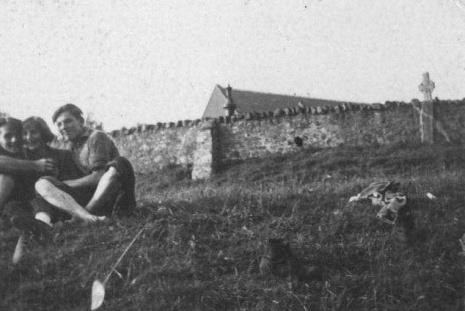
Most of the old graves are graves of the MacKintosh clan as this area was known as the Clan lands and the old records refer to the parish of Moy and not Strathdearn as it now called. The baptismal font is said to go back to the days when Christianity first came to the district. For centuries the font, hewn out of a lump of rock from the river, stood in the churchyard where baptisms were performed in the open air. Sometime later a minister, fearing for the safety of the font, had it moved into the church where it still stands today. Also what once stood against the church porch and is now also inside the church is what is called ‘the bargaining stone’. This stone, with a hole through the top of it was where, in days gone by, a formal bargain would be sealed for any kind of trading. The deal would be conducted by shaking hands through the hole and also, marriages would be pledged by the same method. It is also said that in the days of illicit whisky making, the pulpit was used to hide the still from the Exciseman – probably with the approval of the minister!
Back on to the road and two or three hundred yards down we come to the old Dalarossie School and Schoolhouse. It was here that the children of the Glen would have gone to school as it was central to all the places in the glen and therefore within walking distance for the children. It closed in the late 1940’s as the Glen became less populated and the children were then sent to Raigbeg school .When I was as at Raigbeg school ‘Mammie Freech’ who lived in Dalarossie Schoolhouse came down the Glen to the shop every week with her Shetland pony and gig for her weekly groceries. We children would make a great fuss of the pony. It was a very gentle wee animal, black and white and as fat as a barrel and the gig looked as if it was cleaned and polished after every time it was used. The pony must have known the road well for sometimes it would be dark before she set off for home with only a candle in the lamps on either side of the gig for light. (I don’t know what her real name was or if ‘Mammie Freech’ was in fact her real name that is all that I remember her ever being called)
Another mile on was Corrievorrie, the farm of Allan Tulloch, the same Allan that was with Jock Latham when they crashed in Tomatin as I recounted earlier. Allan never married but was great fun when he had a dram or two. When he died the farm was not leased again but was retained by the Estate for grazing sheep.
Auchintoul, Kyllachy and Woodend
The next place, about four or five hundred yards down the road and almost as far again down off the road to the right towards the river was Wester Auchintoul or Auchintoul Lodge as it was later called. This was where Mrs Boyd stayed. Before she became Boyd she was married to Colonel Hardy the Laird of Kyllachy Estate and on the death of the Colonel she became the Laird of Kyllachy and later married Mr Boyd who was the factor for the Estate at the time. Old Mrs Boyd was a great fly fisher and I seem to remember she spent most of the summer fishing for salmon. She was not a very big lady and I often wondered how she could handle that big heavy greenheart rod. She was also a very good employer and old Willy MacKay was her constant companion when she went fishing and she would often stop at the Freeburn Hotel for him to have a drink on their way home.
Within sight of Auchintoul Lodge was the Auchintoul Farm of the same name which was the home farm for the Estate. There were a few employees who worked there and perhaps the ones that I remember most were the Bow family, not so much the family but more the daughter who was a friend of Kathleen my sister. I took her home once or twice and again this was someone who went away from Tomatin and who I lost contact with over time until one day in 2011, a lad that I knew from Carrbridge called Freddy Paul arrived at my door and asked me to come out to his car as there was someone who wanted to meet me – it was Mhairi Bow. Unfortunately we were waiting for my brother-in-law to arrive from South Africa where June’s brother emigrated to in 1965. However Freddy promised to take her back sometime to see me.
Along the road on the left before going down the Kyllachy brae was the Gardener’s Cottage which was where the Lodge gardener stayed. Kyllachy gardens were the best kept gardens in the district and at one time they were open to the public for one weekend in the year.
Down the steep brae on the left was a tall hedge of rhododendron which shielded Kyllachy Lodge from the road. The drive into the Lodge was straight on from the Gardener’s Cottage entrance. It was at the game larder beside the Lodge that we met to go grouse beating as there was no pheasant shooting in Tomatin back in those early days. The first pheasant that I saw in Tomatin was in 1958 at Soilshan. It was a hen pheasant and was such a rare sight that I had to go home and look it up in a book.
The Kyllachy Lodge drive carried on past the lodge and came out at the bottom of the brae where the Keeper’s Cottage was. This cottage was on the left of the drive and was where Willy MacKay (the same Willy that went fishing with Mrs Boyd) and his wife stayed with their son Andrew who worked on the railway for a time and later started up a fencing business for which he provided a lot of work at the weekends for many of the lads who wanted to make a little extra pocket money. Andrew also ran the taxis in the village and when I last spoke to him in 2011 he was still running the taxi, taking the school children to school every day.
Wester Woodend was where a Cameron Macintosh farmed. It was on the right, below the road with it’s fields running down to the river. The neighbouring farm was Woodend which was run by another Cameron Macintosh. I cannot remember who was who or which one stayed in which farm as there were three brothers, living in three farms, side by side.
I also think that one of those farms was where John Cameron Macintosh, who now owns Morile Farm, was born. The third farm was Ballnaboduch where Donny Cameron Macintosh lived. I know this because he was called Donny Ballnaboduch, after the farm.
Between the farms at the road side was a small cottage where Greeta Green stayed. Gwen Grant recalled Greeta’s father being the butler at Kyllachy Lodge although this was before my time. The next house was Woodbine Cottage where Storey moved to from Corrybrough which I mentioned earlier on. Storey used to sing at the concerts and always sang the same song about meeting some girl in the garden where the potato’s grow. As wee boys we would all sit at the front and join in with the chorus. He sang it so often we all knew it off by heart.
The last farm on the road was Dell Farm which was again on the right, in fact all the farms were on the right of the road because as you travelled down the road from the top of the river to Bridgend all the flat land was between the road and the river, the road following the contours of the hill on the left. The farmer of the Dell was Old Macdonald, not the happy old man of the song but a deeply religious one who’s treatment of his fellow humans was not in keeping with what he called ‘the good book’. Before any food could be eaten in his company or even a cup of tea you would have to endure a lengthy prayer. I can see him yet sitting at the table head bowed rubbing his bald head as he chanted on and on and by the time you got to drink your tea – it was cold! The reason that I know this was that when I first got married I would do some extra work for his son Ian who was working the farm by this time as his father had retired. Ian took on the running of the place although his father still lived there, with Ian and his wife Mary. Ian was good to work for and was good company to be with, as was Mary. Later Ian went on to become the local councillor for Tomatin district.
The next cottage was built into the bank on the left and it looked a dark and damp house, built right on the side of the road and in among big trees. This was Dell Cottage and the home of another Cameron Macintosh.
Angie Harry was the local councillor before Ian challenged him for the job and won. Angie Harry also went out to the beating although he was overweight. Thankfully the keepers took pity on him and let him go flanking. Flanking was an essential part of driving grouse that did not need a lot of walking. For Angie it was more for the banter and the dram or two that were always on the go after the day was done that he liked best. They had three of a family, John and Ann who both died very young and were in school with me and the older girl’s name was Betty.
Across the road were his sheds and garage. I remember one time there was a big gale and a tree was blown down on to his garage, smashing the roof down on his car and its contents. When asked if the tree did a lot of damage his reply was ‘it smashed my fishing rods to atoms’, no word about the car which was a write off and it was a beautiful Humber Super Snipe. There was one more cottage on the glen road and that was Dell View and it was here that Ian and Mary ‘Dell’ retired to.